Production-grade AI for utilization management: faster decisions, fewer appeals, less manual workProduction-grade AI for utilization management: faster decisions, fewer appeals, less manual work
Overview
Coditas helped design and build an AI-native utilization management platform that took prior-authorization turnaround time (TAT) from days to hours, cut the resources required to process an authorization by up to 67%, and drove data-validation errors to near zero, now running in production for risk-bearing care organizations serving frail, dually-eligible seniors.
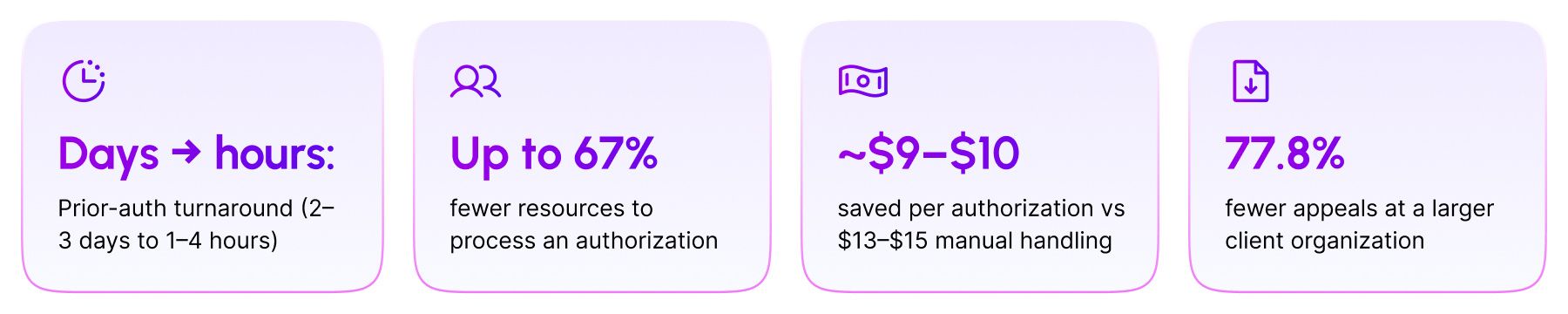
In production for over a year | In daily use by clinical reviewers across client organizations | Well inside the CMS-0057 turnaround window.
Built for the frailest patients and the tightest rules
The client is a US-based, AI-native, venture-backed utilization management (UM) platform company, built with input from dozens of UM professionals, that is modernizing how health plans and risk-bearing organizations decide what care to authorize. It engaged Coditas to design and build its platform. Today that platform runs in production for risk-bearing care organizations delivering fully capitated, all-inclusive care to frail, mostly dually-eligible seniors under the PACE model (Program of All-Inclusive Care for the Elderly), among the most clinically complex and tightly regulated populations in US healthcare.
For an organization that carries the financial risk for a population's care, utilization management is not back-office paperwork. Every slow review delays care for a frail patient, and every inconsistent decision carries clinical, regulatory, and financial consequences.
Clinical judgment, trapped in manual work
In utilization management, clinical judgment is the point. Everything around it was friction, and that friction had piled up into a slow, error-prone, expensive process:
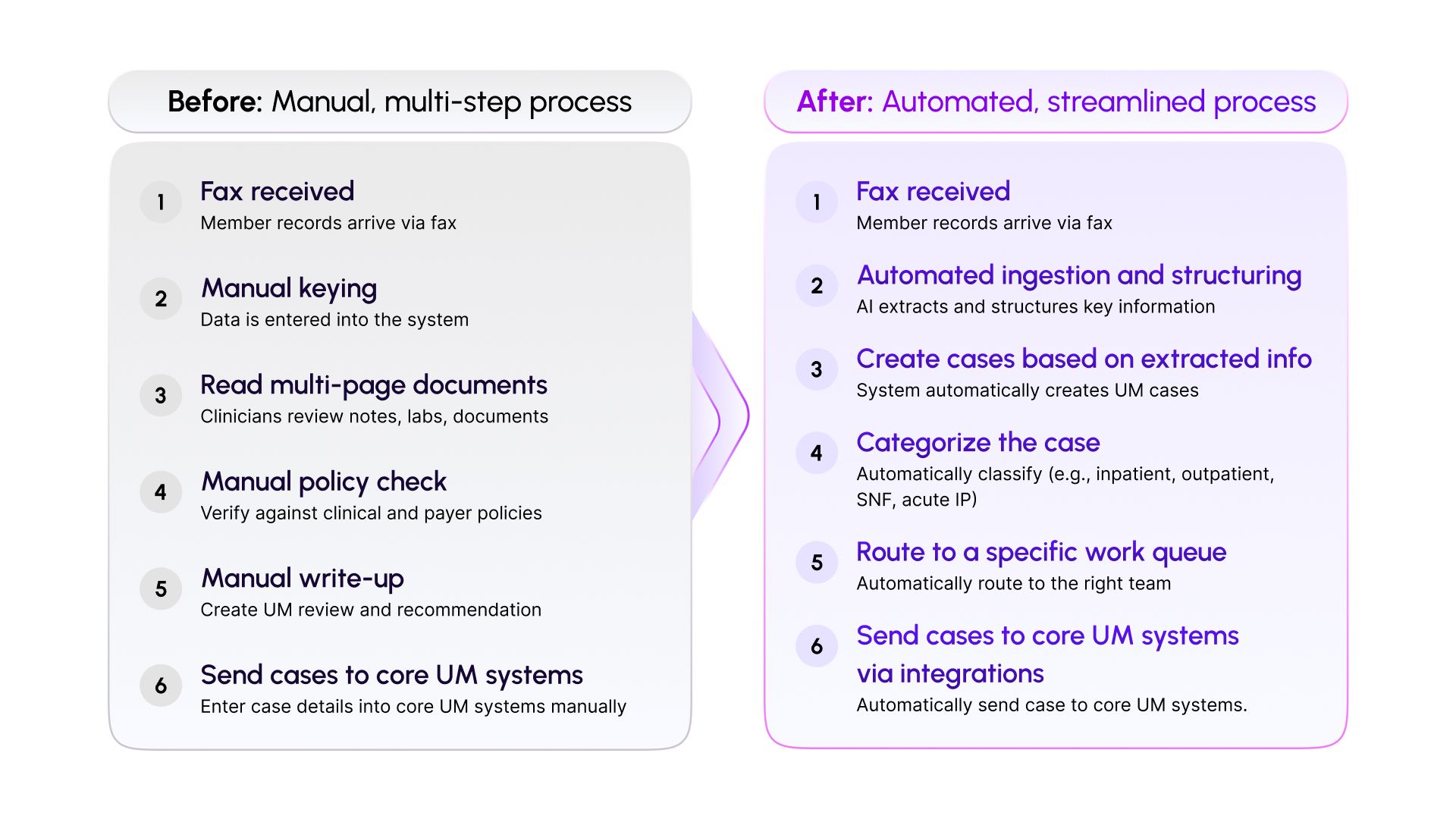
- Manual intake. Requests arrived by fax and were keyed into cases by hand, one at a time. In the industry, each inbound fax costs roughly $13 to $15 to handle, and authorization-related contacts can drive up to 40% of a plan's call-center volume.
- Unstructured records. Clinicians combed through lengthy PDFs and scans to find the few facts that mattered.
- Cognitive overload. Every determination meant synthesizing scattered records against standard criteria (such as MCG and InterQual) and plan policies, case after case, which slowed decisions and invited errors.
- Data-validation errors. A high rate of Electronic Data Interchange (EDI) validation failures created downstream rework and compliance exposure.
- High appeals volume. Appeals ran high, a lagging signal of inconsistent first-pass decisions and added load on a stretched team.
The burden is well documented: providers spend an average of about 13 hours a week on prior authorization, and 94% of physicians report that prior authorization delays access to necessary care. And the regulatory clock is now formal. The CMS Interoperability and Prior Authorization Final Rule (CMS-0057-F) requires impacted payers to return decisions within 72 hours for expedited and seven calendar days for standard requests, phasing in from 2026. Manual UM cannot reliably meet that. Automation is becoming a compliance requirement, not just an efficiency play.
Removing utilization management is not the answer. Independent actuarial modeling has estimated that eliminating prior authorization could raise commercial premiums by roughly $600 to $1,500 per member each year, even as low-value, unnecessary care already costs the US health system an estimated $340 billion a year, and nearly 90% of doctors report negative impacts from low-value care. The goal is not less oversight. It is utilization management that is quicker, more consistent, and more efficient to operate, without giving up the clinical control that keeps care appropriate and costs in check.
Why fax, not email, won
UM has operational realities invisible from the outside. One shaped the build: despite the appeal of email, fax remains the reliable operational channel for intake in this setting, so the team standardized on automated fax ingestion rather than forcing a channel that would create gaps. Designing to how utilization management actually runs, rather than to an idealized workflow, is what earned clinician adoption and let the platform accelerate the work instead of obstructing it.
Built from the workflow, not the model
Coditas started with the clinical workflow and the people doing it, not with a model looking for a use case. Working alongside experienced UM clinicians, the team mapped each step of the review, found where automation would remove effort without removing judgment, and built to that. The guiding principle is that the platform is a co-pilot, not a decision-maker.
The platform reflects a hard rule of utilization management: a nurse cannot issue a denial alone, and every potential denial routes to a physician. Coditas built to that boundary from the start. The platform structures information, summarizes records, and surfaces recommendations against policy so clinicians reach decisions with less effort and apply criteria more uniformly. It never denies care. That decision is kept in human hands by design. The aim was never to maximize automatic approvals. In utilization management, the decisions that matter are the ones made with swiftness, dependability, and the documentation to defend them, while a clinician stays in control.
What Coditas delivered
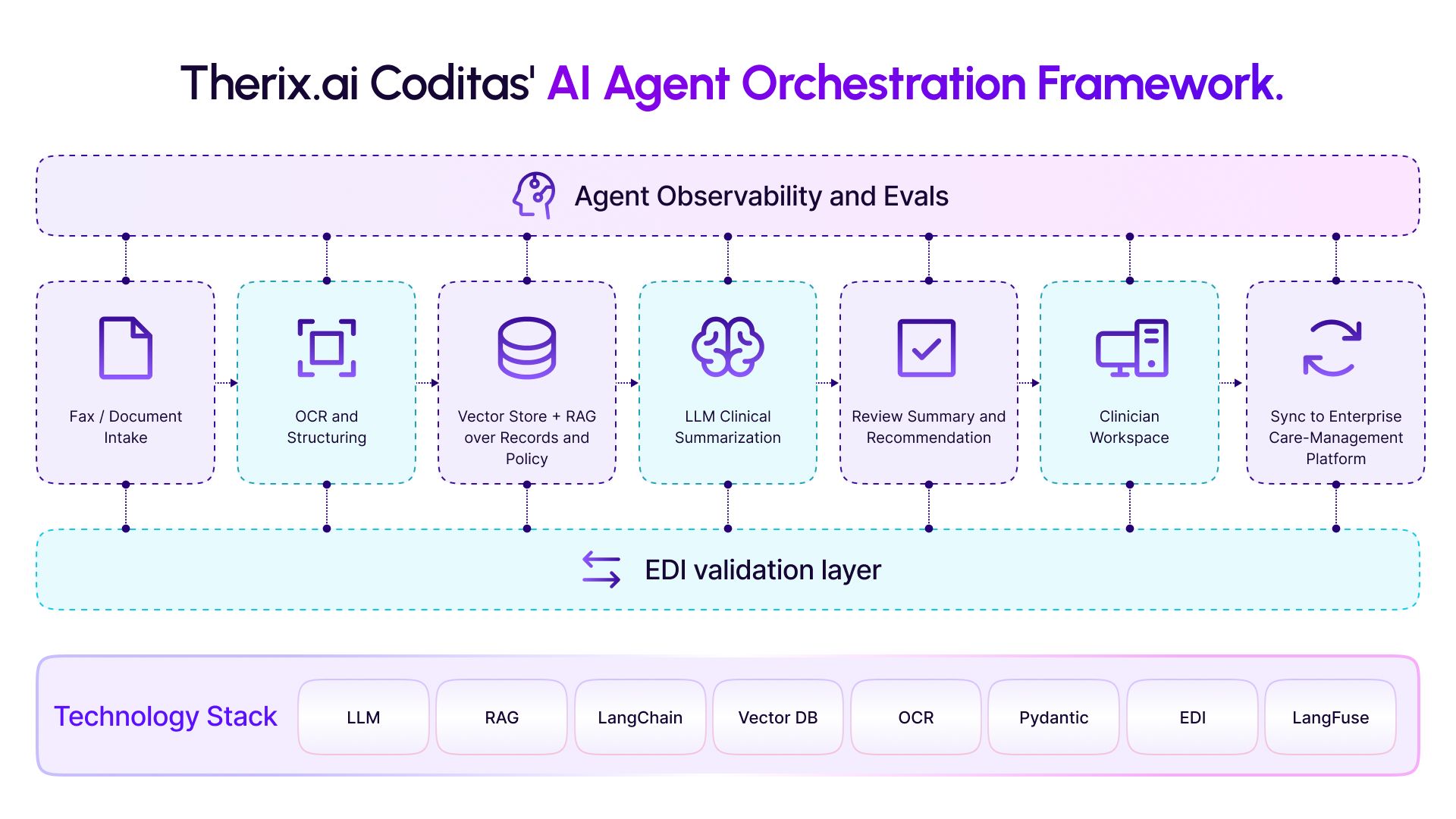
Coditas built the client's end-to-end, AI-native UM platform on Therix.ai, the framework Coditas uses to build, connect, observe, and safely deploy production GenAI agents inside enterprise systems. The platform spans the utilization management lifecycle (prior authorization, concurrent review, and appeals and grievances), and gives clinical and operational leaders visibility into utilization trends, turnaround, and workload. Live in production today:
- Automated fax intake and document ingestion, turning inbound faxes into structured cases without manual keying.
- Structuring of unstructured records, converting PDFs and scans into structured, searchable data.
- Automated case creation and queue assignment, so work is ready for a reviewer the moment it arrives.
- AI clinical summarization, compressing lengthy records into concise, reviewable summaries.
- AI review summaries and recommendations, generated against clinical policy and case specifics to support consistent determinations.
- Integration across the systems UM depends on: a leading enterprise care-management platform used by US health plans, CMS, and third-party clinical policy sources, so cases, policies, and authorizations flow between systems without manual re-keying.
The platform serves several client organizations, each with isolated data and its own configuration, on shared infrastructure built to onboard more.
Under the hood
The stack: large language models with retrieval-augmented generation (RAG) over the client's records and policies, orchestrated with LangChain; a vector database for retrieval; OCR for document capture; Pydantic-based validation for structured, reliable outputs; a dedicated EDI integration layer; and Langfuse for full observability of every agent step. All composed, monitored, and deployed through Therix.ai.
Real caseloads, measurable gains
The platform was measured against the manual process in a controlled comparison of matched reviewer groups working comparable cases over roughly eight and a half months. The operational figures in this section are measured, not projected.
Turnaround went from days to hours
End-to-end prior-authorization TAT dropped from days to hours at client organizations: from two days to about one hour for one client, and from three days to about four hours for another. Separately, the time from first inbound file to a created case fell from a median of about three hours to 6.4 minutes. Both sit comfortably inside the CMS-0057 turnaround limits.
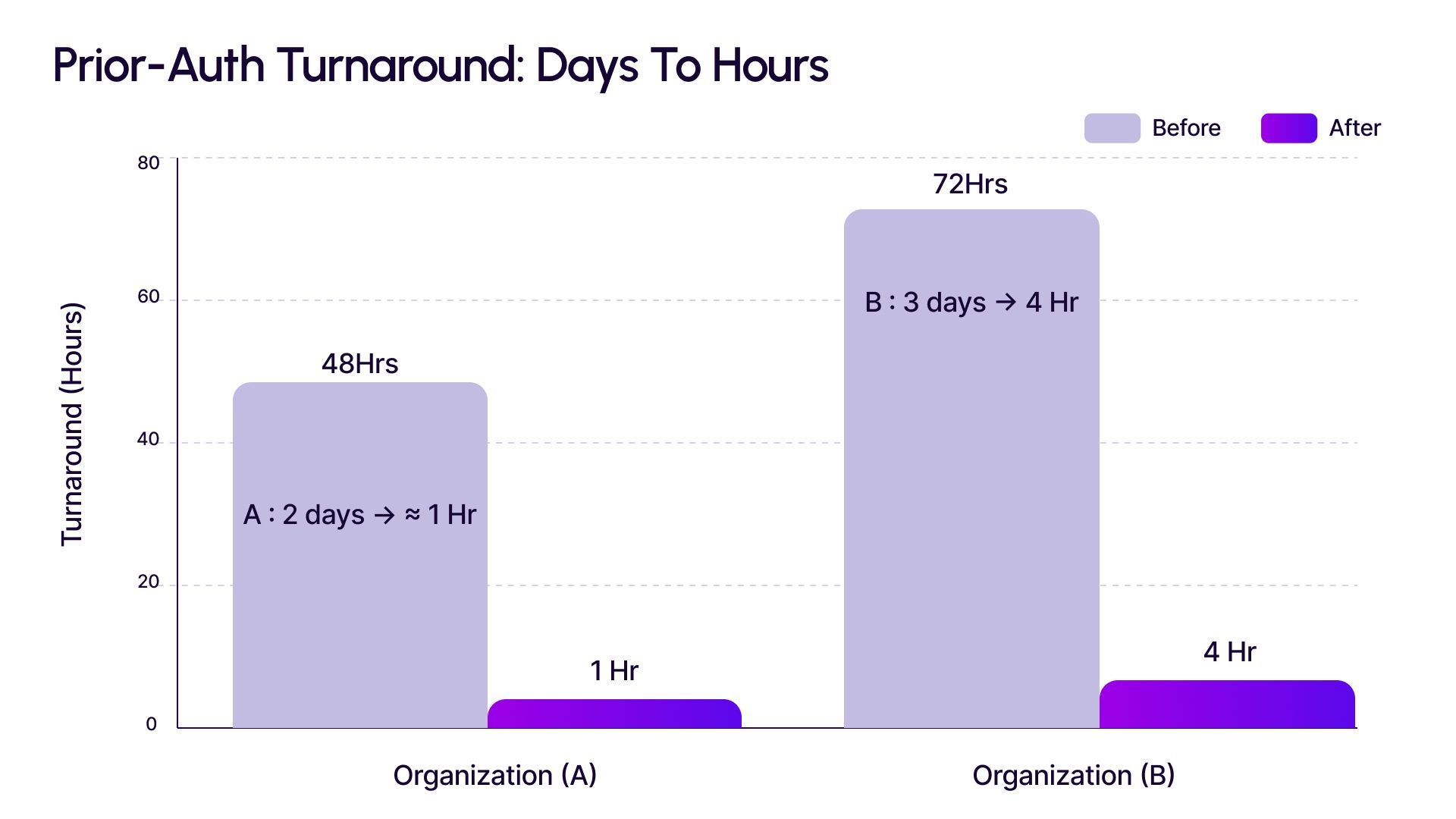
End-to-end prior-auth turnaround, before vs after (in hours)
More capacity, less rework
By automating intake, structuring records, and drafting review summaries, the platform sharply reduced the manual work each authorization demands. The same clinical teams handle materially higher volume, spending their time on judgment rather than administration, which is what let client organizations scale throughput with the same headcount.
Data quality approached zero defects
EDI validation errors, a direct driver of rework and compliance risk, fell from 10% on initial reviews and 15% on concurrent reviews to 0.01% on both, relative reductions of roughly 99.9%. Measured as failed validations over total EDI transactions, using identical rules for both groups. This is a platform-level result across client implementations.
Fewer appeals, better first-pass decisions
At a larger client organization, appeals fell from 45 to 10 per 100 cases, a 77.8% reduction. Fewer appeals point to more consistent, better-supported first-pass determinations, cutting provider abrasion and member friction.
Adoption scaled with trust
Adoption scaled with trust. As clinicians came to rely on the platform, monthly volume grew 4.5x at one client organization and 4.3x at another. Usage rising by that magnitude, sustained over months, is the clearest signal that reviewers trust the platform with real caseloads, not just pilots.
A senior UM clinician, after the platform's recommendation differed from the team's original call on a complex case:
"I actually agree with the agent's choice over what we originally went with. It took me about 20 minutes to compare and confirm that I agree."
-Senior UM Clinician, end-customer organization
The economics
Manual utilization management is expensive to run. Handling a single authorization the traditional way, keying faxes, chasing documents, and working across systems, costs an estimated $13 to $15 per case in administrative effort by industry benchmarks. It is one of the most labor-intensive back-office functions a risk-bearing organization operates.
By the company's own measurements, the platform cuts the resources required to process an authorization by up to 67%. Applied to an industry manual-handling cost of $13 to $15, that takes roughly $9 to $10 out of the administrative cost of every case. At a larger client organization's volume of more than 4,000 cases a month, near 50,000 a year, that is on the order of $450,000 to $500,000 a year in administrative cost, before counting other client organizations or the compounding effect of faster turnaround and fewer appeals.
For a leader carrying utilization risk, the combination of lower cost per case, faster member access to care, and fewer errors and appeals lets a UM operation absorb rising volume without proportionally rising cost.
Compliant by design
The platform operates under SOC 2 Type II, and completed an independent third-party HIPAA assessment in 2025 with no material deficiencies. Data isolation between client organizations, role-based access, and full observability of every AI step are built in, appropriate to handling protected health information for a frail, high-risk population. By automating intake and review, the platform also positions payers to meet CMS-0057 turnaround requirements with room to spare.
From engagement to strategic partnership
The platform's integration with a leading enterprise care-management system used by US health plans did more than move data. It became the foundation of a strategic partnership that opens the platform to that system's health-plan customers. Coditas's role did not end at the build: the team continues to support implementation and to deliver the complex third-party integrations across care-management systems, CMS, and clinical policy sources that make the platform work in each new environment. A build engagement grew into a durable commercial relationship because the engineering behind it keeps making new deployments possible.
The client's CEO and co-founder, on building with Coditas:
"Coditas moves fast, understands complex healthcare workflows, and brings real AI capabilities to the table. They took us from concept to production faster than we thought possible, without cutting corners. They're a true extension of our team."
-CEO and Co-founder, an AI-native utilization management platform company
About Coditas
Coditas is an engineering services company that designs and builds production-grade software and AI for healthcare and other regulated industries. For the client, Coditas built an AI-native utilization management platform end to end, from intake and document AI to clinical decision support and enterprise integration, onTherix.ai, and took it from concept to production with live client organizations.
References
Availity, "Availity's Authorization Solution," case study. https://www.availity.com/case-studies/availitys-authorization-solution/
American Medical Association, prior authorization physician survey. https://www.ama-assn.org/practice-management/prior-authorization
CMS Interoperability and Prior Authorization Final Rule (CMS-0057-F), 2024: impacted payers must send prior-authorization decisions within 7 calendar days for standard requests and 72 hours for expedited requests, with these timeframes effective in 2026.
Milliman, "Potential impacts on costs and premiums related to the elimination of prior authorization requirements," 2023. https://www.milliman.com/en/insight/potential-impacts-costs-premiums-elimination-prior-authorization-massachusetts
University of Michigan Center for Value-Based Insurance Design, "Reducing the Utilization of Low-Value Care." https://vbidcenter.org/initiatives/low-value-care/
JAMA, Ganguli et al. https://pubmed.ncbi.nlm.nih.gov/34870673/
Build an AI Strategy Your Teams Can Act On

Ashutosh Zatke
Director - Growth Strategy
When you win, we win.
Our Offices