How Coditas Turned a Big Four Tax Platform Into AI-Powered IntelligenceHow Coditas Turned a Big Four Tax Platform Into AI-Powered Intelligence
From Legacy Platform to Competitive Intelligence
“The unified tax platform is already proving to be a game-changer, enhancing efficiency in managing our tax compliance and litigation-related tasks.”
- Head of Tax, multinational technology and engineering services group
$360M+ in tax litigation tracked | 26K+ tax compliances tracked | ~90K tax notices auto-downloaded | 5M+ tax documents stored and searchable
How India’s Largest Enterprises Now Turn Tax Data Into Advantage
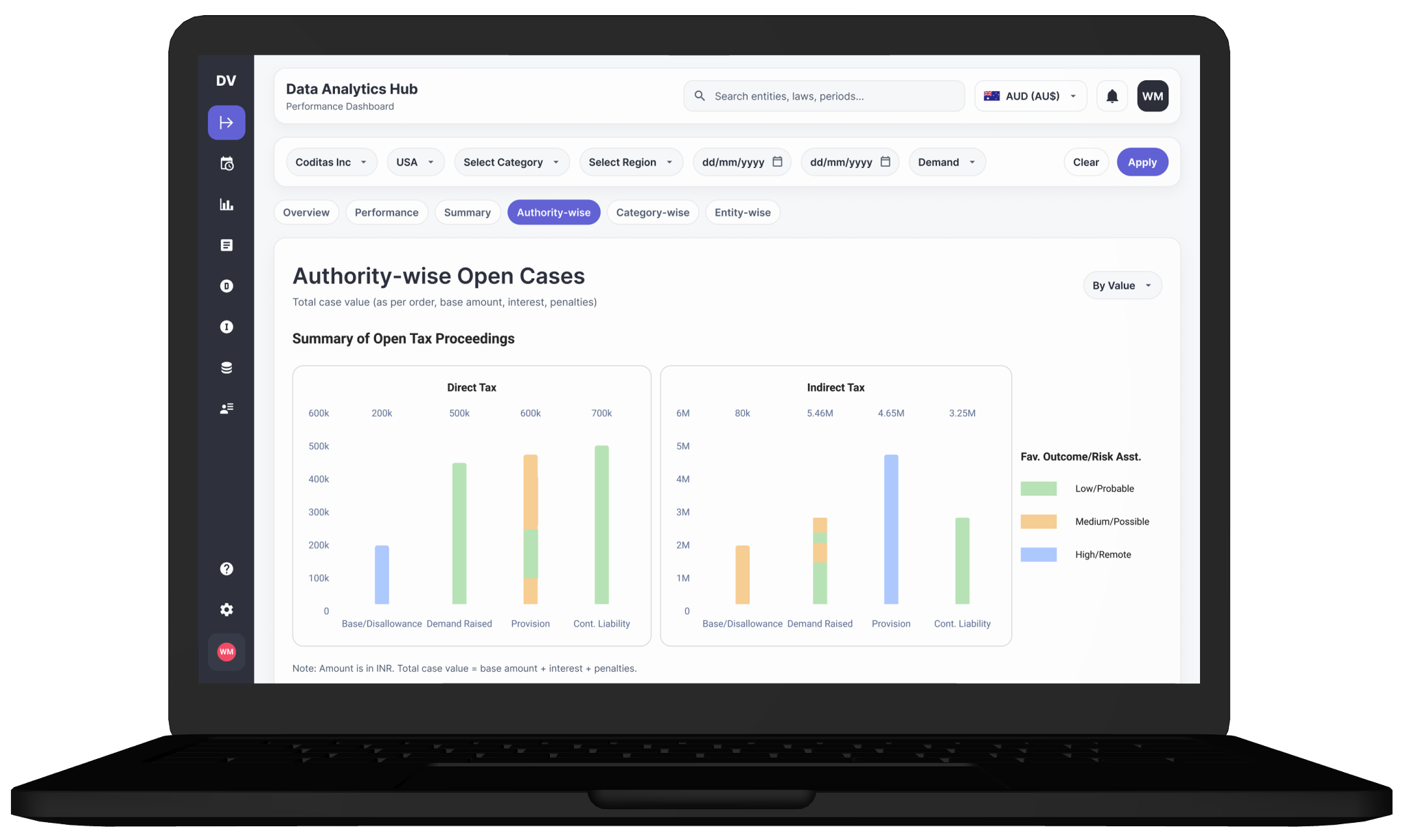
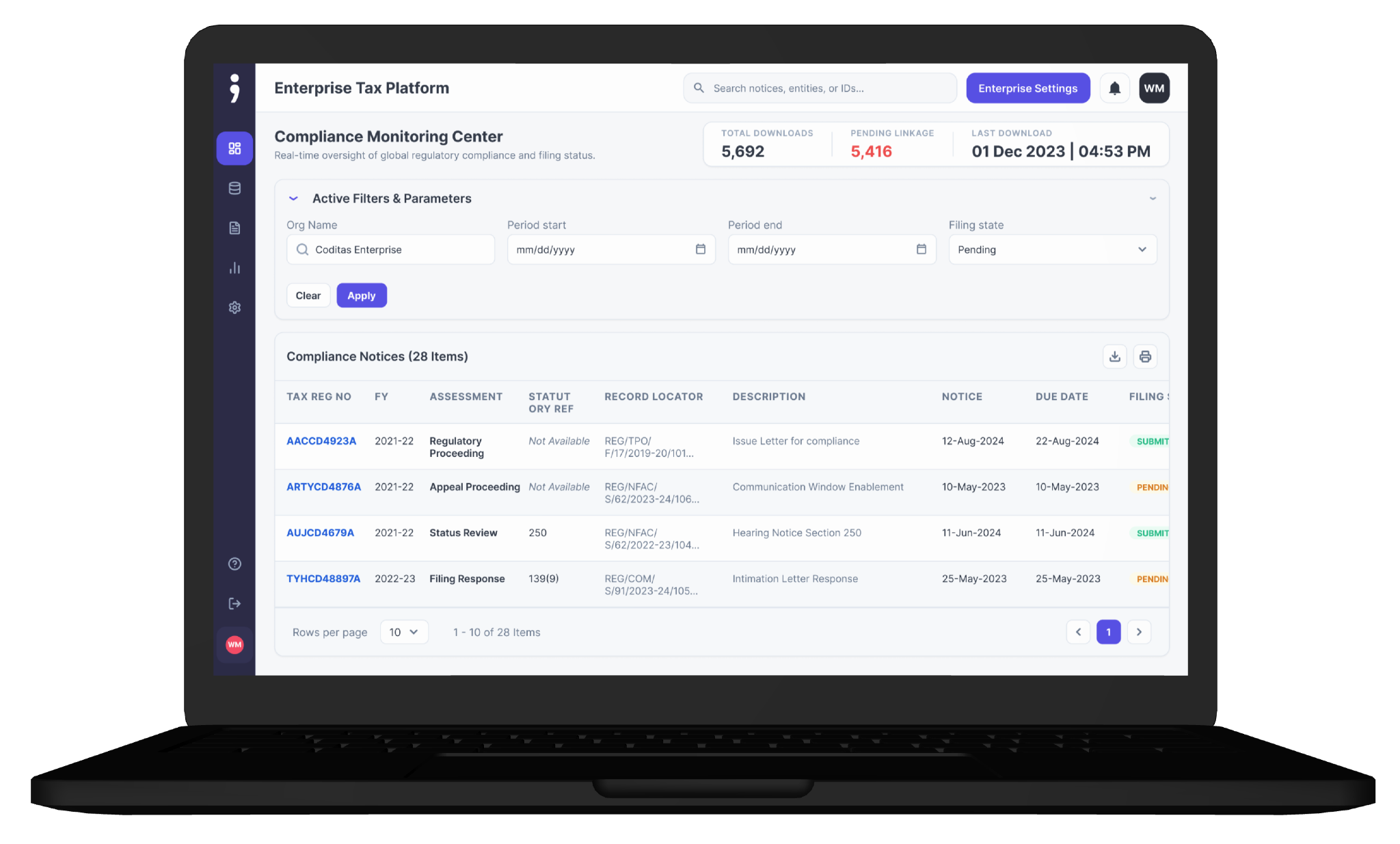
One of the Big Four’s unified tax platform tracked over USD 360 million in active tax litigation, ~90K auto-downloaded notices, and 5 million tax documents. For direct and indirect tax managers tracking live assessments, pending hearings, and filing deadlines on the platform, opening a case meant waiting up to 10 minutes for the screen to load. Even then, some queries against active assessment records returned incomplete results. Case documents filed against assessments and proceedings could not reliably be retrieved as only 35% of the platform’s designed functionality was truly accessible, and only 15% of subscribers were actively using it.
The unified tax platform had been built to help the firm’s clients centralize and manage enterprise tax litigation data and the platform accomplished that. As it scaled, the sheer volume of the firm’s client base and the complexity of their litigation portfolios grew well beyond what the original architecture was designed to support. The platform needed to evolve to meet demands of the data-powered future.
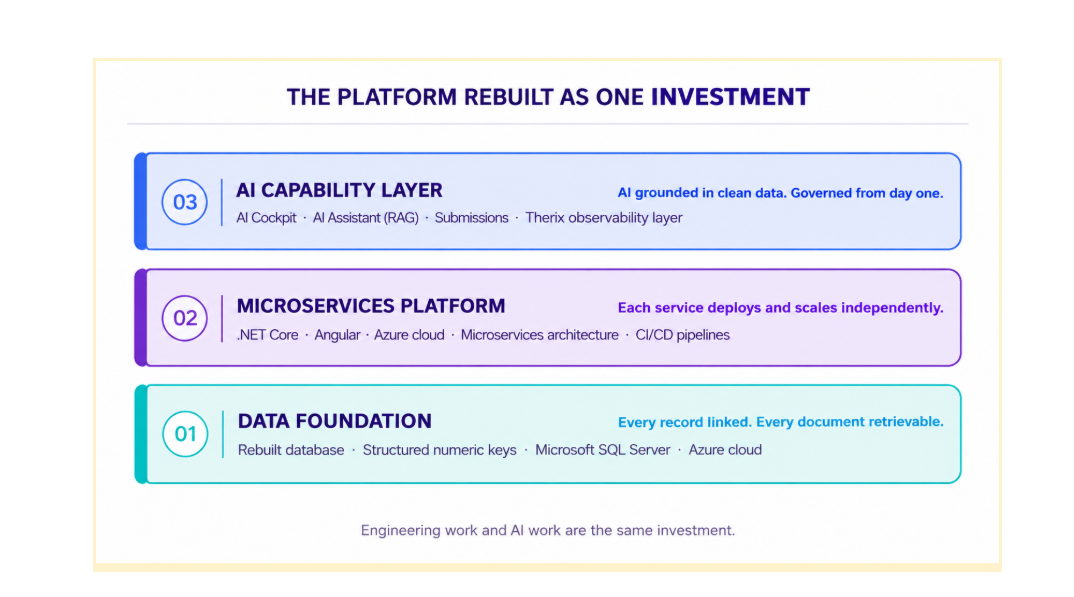
One of the Big Four approached Coditas to rebuild the platform from scratch. Using the ATOM framework, Coditas addressed each constraint in sequence: governed data architecture first, then the microservices platform, then the AI capability layer. The new system went live in August 2025. Today, 100% of the platform is functional. Over 95% of subscribers use it actively. The heaviest screens load in under 10 seconds. The platform has run without a single production incident since go-live.
What began as a mandate for performance and modernisation has since evolved into a multi-faceted strategic partnership, expanding upwards from the foundation Coditas built.
Read the detailed case study below:
The Challenge: Accuracy, Accessibility, and Adoption
Tax litigation management is operationally unforgiving. A missed hearing date or an untimely reply to a notice from the Income Tax Department or GST authorities can trigger penalties and interest charges directly leading to millions of dollars in losses. The hearing calendar, the assessment and proceeding history, the supporting documents, the draft submissions: all of it must be accurate, accessible, and retrievable on demand.
The Data Architecture Problem
The unified tax platform stored tax litigation data across hundreds of enterprise clients, including one of the world’s top-ten global systems integrators (GSIs) managing technology transformation across 60+ countries with over $10 billion in annual revenue, one of India’s top-five private sector banks with income tax obligations nearing $1 billion in FY2025, and one of the world’s largest diversified natural resources companies across multiple continents, with an annual revenue of over $17 billion.
Coditas’s approach to a platform at this stage of growth began with a diagnosis, not a solution. The team traces backward from surface symptoms to the layer where the constraint actually lives: whether the data architecture can support the volumes being asked of it, whether the people working within the platform have the visibility they need to act with confidence, whether the institutional knowledge the platform holds is accessible at the speed the work demands, and whether the architecture can carry what the practice needs to build on top of it. What that assessment revealed here was a set of compounding constraints, each one a consequence of the layer beneath it.
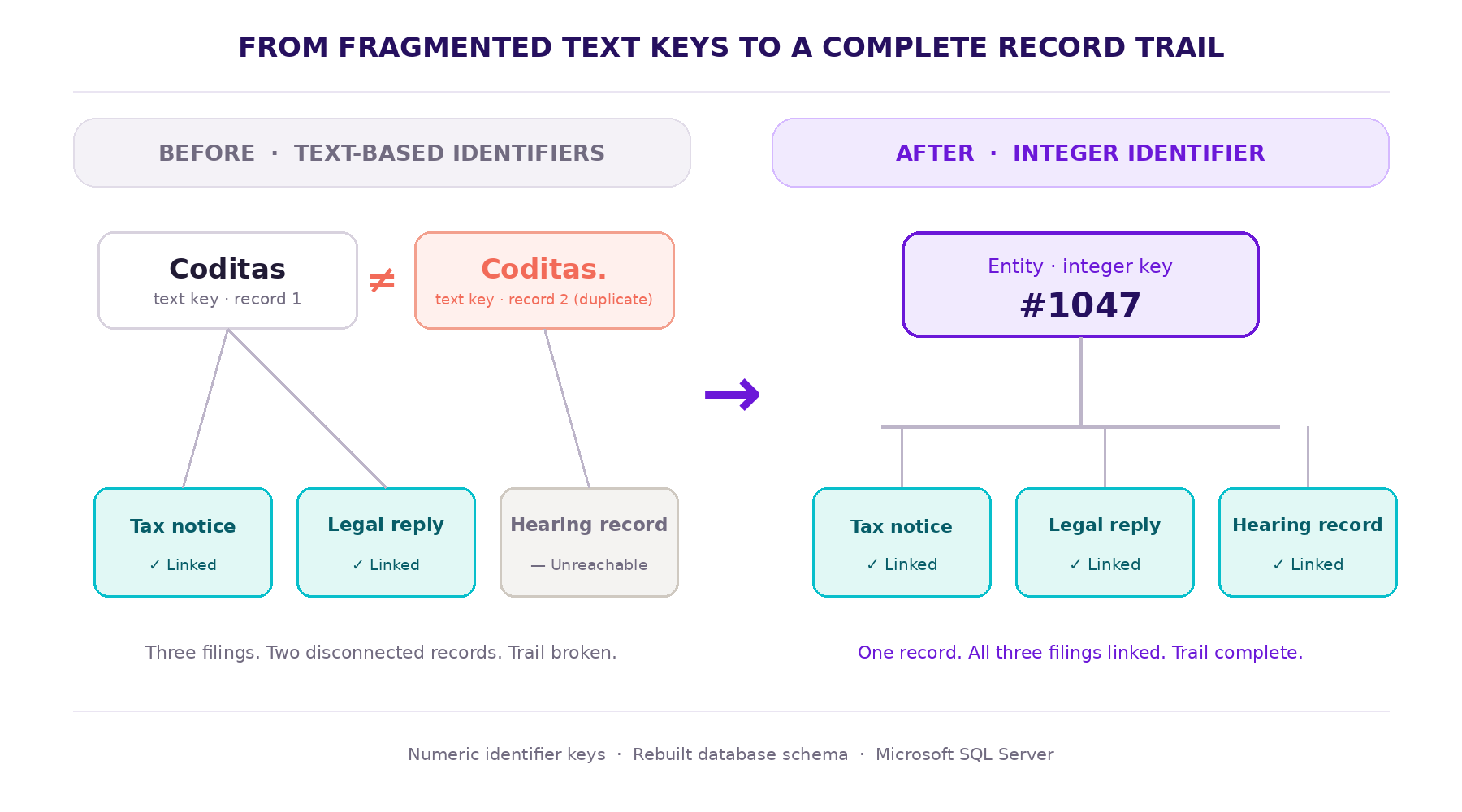
The underlying problem was that records were linked by textual identifiers rather than structured keys. An organisation’s name entered as “Coditas” and the same name entered as “Coditas.” (with a trailing punctuation mark) were stored as separate entities. A litigation matter built up over three years, with assessment notices, written submissions, order sheets, and appeal filings, could not be traced end-to-end because the identifiers connecting those records did not consistently match. While the data existed, the system could not navigate it.
The Knowledge Problem
The document layer reflected the same structural gap. Users uploaded case-related files: demand notices and show cause notices, written replies to the assessing officer, and documentary evidence submitted during proceedings. The platform could not reliably return them on retrieval. There was no hierarchical structure linking each document to its parent assessment or proceeding, its assessment year, or its proceeding stage. Documents were in the system with no consistent path back to them.
The Visibility Problem
Without a dedicated logging layer, the system had no mechanism to surface workflow status or flag processing errors. Tax litigation specialists and compliance officers working under hearing response deadlines and return filing due dates had no way to know whether an action had been processed. The interface did not consistently surface all data fields — some data captured in the system did not render in the views designed to display it. The platform had been built to give users a structured view of their litigation portfolio, by authority, by assessment year, by notice type. As the volume of data grew, the underlying architecture could not reliably sustain that view.
The Scale Problem
As the volume of tax compliance data on the platform grew to over 26,000 tracked compliances and 5 million stored documents, and more complex portfolios moved onto the platform, performance degraded. The architecture had been designed for a fixed, contained user base. It scaled only by adding RAM or CPU to a single server. The heaviest screens, the ones direct and indirect tax managers needed most when preparing submissions for assessment hearings or tracking upcoming return filing deadlines and appeal due dates, took 8 to 10 minutes to load. Some did not load at all. 65% of designed features were effectively inaccessible.
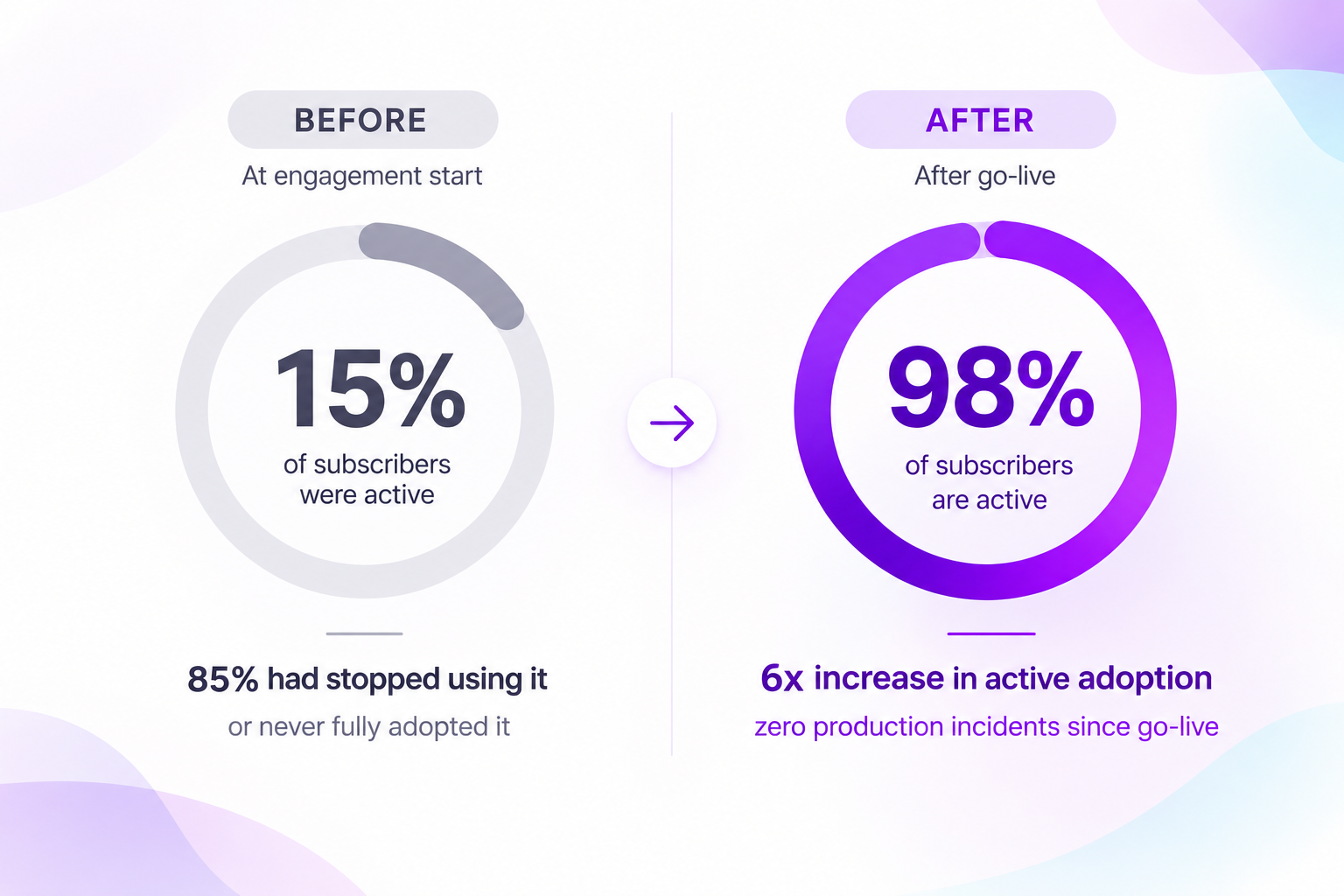
The consequence was visible in adoption. Of all the enterprises that had subscribed to the unified tax platform, 85% had either stopped using it or never fully adopted it.
The Mandate
The firm came to Coditas with four priorities: performance, modernisation, cloud migration, and scalability. The AI capabilities that followed were not in the original scope. They came after, once the engineering work demonstrated that Coditas could deliver what the firm needed.
The Approach
The original brief had four gaps: poor performance, an outdated technology stack, limited scalability, and no AI capability. Coditas applied the ATOM framework, beginning where it always begins: with a diagnosis. The knowledge transfer phase covered the existing codebase, infrastructure, backlog, and open bugs — not to execute a handover, but to understand what the platform was actually constrained by before proposing how to rebuild it.
Coditas’ key early findings shaped everything that followed. The performance ceiling was architectural. No amount of optimisation on the existing stack would produce a platform capable of handling AI workloads, serving enterprise clients at scale, or supporting both SaaS and on-prem deployments simultaneously. Addressing all four of the firm’s gaps required the same intervention: rebuild the foundation.
As part of the modernization process, Coditas built in an AI enablement layer at the very start, not as a follow-on project. The AI Cockpit and AI Assistant were designed into the rebuilt platform from the beginning. The firm agreed. The engagement has since expanded into an ongoing long-term partnership, with the firm’s and Coditas teams continuing to build on the platform they co-architected.
This was proof that we shape what is possible, not just deliver what was specified.
The Solution
1: Database & Data Architecture
The foundation of the rebuild was the database. No performance optimization on the existing system would fix records that could not be found because they were identified by inconsistent text strings.
Coditas rebuilt the database in Microsoft SQL Server using a numeric, identifier-driven schema. Every entity, organisation, litigation matter, notice, and document received a unique and unambiguous numeric key. Searches that previously required character-by-character text comparisons now run against indexed integer lookups. The performance improvement was a direct result of the data design.
The document layer was restructured as a deliberate hierarchy: each document links to its parent case, its assessment year, and its proceeding stage. A litigation specialist or compliance manager can navigate to any point in an assessment or appeal timeline and retrieve the corresponding documents reliably.
2: System Architecture & API Layer
The old unified tax platform was a monolith. One codebase handled all functionality, on a single server, scaled only by adding hardware. There was no separation between the presentation layer, the business logic, and the data layer.
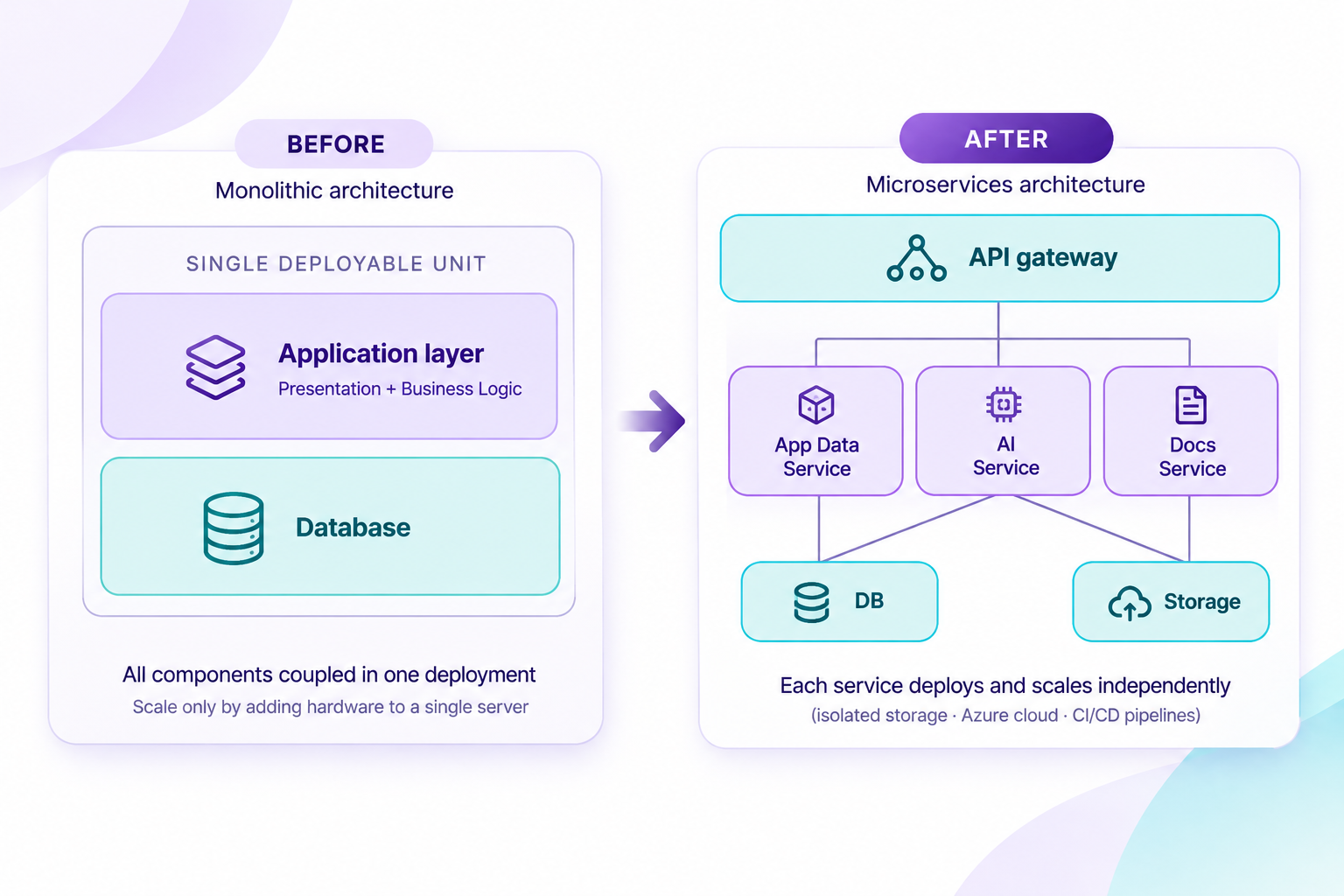
Coditas rebuilt the system as a microservices architecture with independent services for AI processing, data management, and document management. Each service scales independently. The entire API layer was recreated to enforce a clean separation: the Angular (TypeScript) frontend, the .NET Core (C#) business logic, and the Microsoft SQL Server data layer communicate through defined API contracts. The front end, the business logic, and the database can each evolve independently without requiring a system-wide rebuild.
The platform is deployed on Microsoft Azure. Error handling and structured logging were built into every service from the start. Every failure produces a trace. Every workflow logs its state.
Zero Downtime:
The old system remained fully functional while the new platform was built in parallel. When the new system was ready, Coditas executed the backend cutover over a weekend. The new platform replaced the old one with no service interruption and has run without a single production incident since.
Deployment Pipeline
Before the rebuild, deploying to the firm’s production environment was a heavily manual, full-day process. Deploying to an on-prem client environment took even longer.
Coditas implemented a CI/CD pipeline with full version control, a structured branching strategy, and a code promotion process that gates every release through QA and business testing before it reaches production. Deploying the full service stack to the client’s environment now completes in under one hour. On-prem deployments complete in under ninety minutes. There have been no production rollbacks since go-live.
3: AI Integration
AI was introduced as the Solutions layer on top of the rebuilt platform, not as a standalone tool, with three capabilities already live. Each runs in the firm’s own Azure tenant. The firm owns the code, the context, and the agents. All three capabilities are built and operated on Therix, Coditas’s Agent Operating System.
Future-Proof AI
The custom-built AI Assistant uses Retrieval-Augmented Generation (RAG) to let tax professionals interact with individual tax notices in natural language. A user can ask ‘what is this assessment notice or show cause notice asking us to respond to?’ and receive a plain-language answer grounded in Indian tax law context. It functions as a first-read analysis of an assessment notice or order, the kind of triage that previously required a litigation specialist’s or compliance manager’s direct reading time. The capability is built on Azure OpenAI.
AI Cockpit
The AI Cockpit gives users analytical access to the entire litigation database through natural language queries. A user can ask ‘what are our oldest open assessments?’ or ‘what is our total tax demand and penalty exposure for FY26?’ and receive structured answers drawn from live platform data. It converts database interrogation from a reporting task into a conversational one.
AI Ensured Compliance and Reduced Liability
The Submissions capability generates draft replies to assessment notices and orders issued by the Income Tax Department and GST authorities. It references applicable provisions of the Income Tax Act, GST legislation, and judicial precedents to produce a reply structured to reduce the client’s assessed tax liability and penalty exposure. The draft is reviewed and approved by a tax professional before filing. Coditas built the frontend, backend, and database layer. The AI model was provided by a specialist third-party vendor.
The stakes for this capability are direct. Under Section 270A of India’s Income Tax Act, penalties for underreported or misreported income can range from 50% to 200% of the tax payable on the underreported amount. For an enterprise managing a large litigation portfolio, a single poorly drafted reply or missed response deadline can result in adverse assessment orders, additional tax demands, and penalties running into millions of dollars. AI-assisted drafting with human review reduces that risk at scale.
The Underlying Intelligence Layer
The platform’s AI capabilities are instrumented through Therix, Coditas’s Agent Operating System. This tracks token consumption, cost per query, and response quality in real time, giving the firm full transparency on what the AI layer costs to operate. But the more significant function is behavioural intelligence. It analyses how direct and indirect managers phrase their queries: the language they use, the patterns in what they ask, and where the AI’s responses fall short of what users need. That data feeds directly into product decisions: which AI capabilities to refine, which new features to build, and how to improve model behaviour over future iterations. The result is an AI layer that gets more useful over time, shaped by how the actual user base works rather than by assumptions made at build time.
Governance and Delivery
Enterprise-grade software deployments require enterprise-grade governance processes: Architecture Review Board (ARB) reviews, Vulnerability Assessment and Penetration Testing (VAPT), phased security reviews, and infrastructure provisioning approvals. These processes are a feature of responsible enterprise software deployment, not an obstacle to it. Navigating them is part of what Coditas does in engagements of this kind. Coditas is SOC 2 Type 2 certified, and all infrastructure access follows a zero-trust model with full audit logging.
What began as a defined scope has since grown into a strategic partnership. Enterprise AI does not plateau after go-live. Each layer compounds: strategy sharpens as use cases prove out, data quality improves as governance matures, and the capability of the people working within the platform grows with every cycle. The partnership covers ongoing enhancements, AI initiatives, and platform support.
The Impact
Functional Coverage
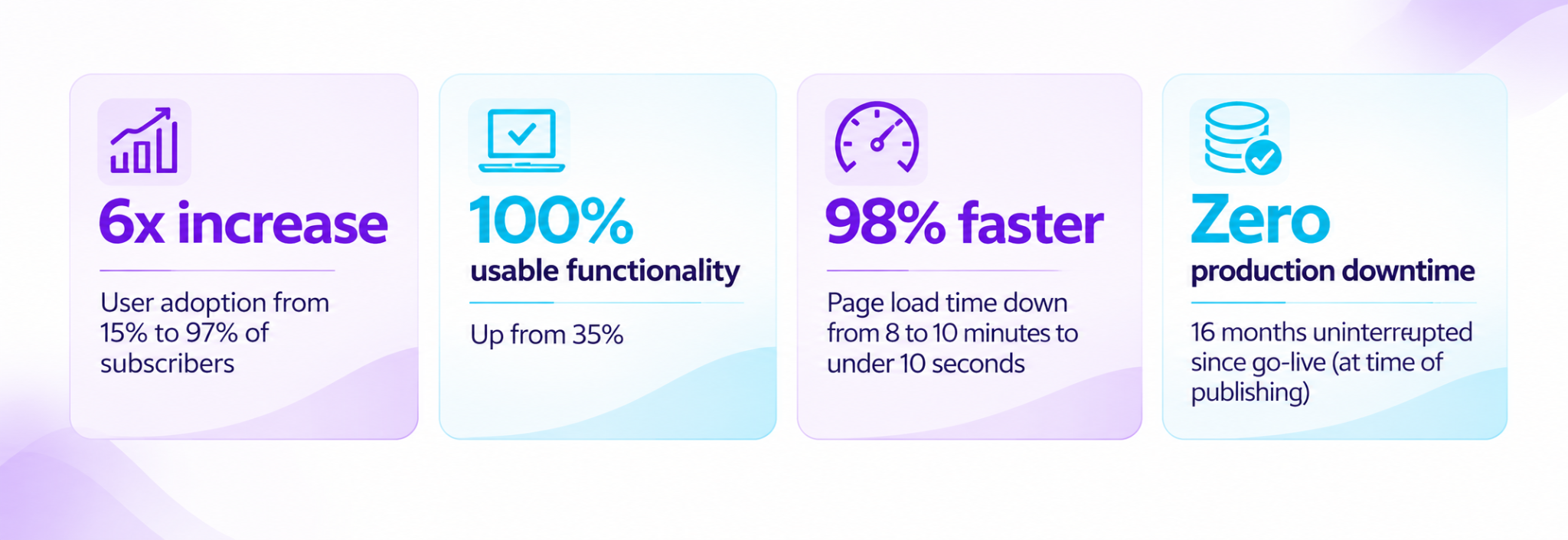
Usable functionality: 100% from 35%.
Before the rebuild, 65% of the platform’s designed features were inaccessible or produced unreliable results. Tax professionals had mapped out which parts of the system to avoid and built their workflows around those gaps. Today, every designed feature works.
User Adoption
The adoption recovery is the most direct measure of whether the rebuild delivered value. Today, 98% of subscribers use the platform actively — a more than 6x increase from where the engagement began. The platform is reliable enough to build professional workflows around.
Performance
Page load time (heaviest screens): 98% reduction, down to <10 seconds.
For tax professionals managing active litigation, load time is an operational constraint, not a user experience preference. An assessment summary that takes 10 minutes to load cannot be opened during a client briefing before a hearing. It cannot be checked when an appeal response deadline is two days away. The performance improvement removed a category of operational risk.
Operational Continuity
There has been zero production downtime since go-live in August 2025. The deployment pipeline has completed every release without a single rollback.
The baseline was a platform where the majority of features were inaccessible. The complete backend was replaced in a single weekend cutover. At the time of publishing, the 16 months of uninterrupted operation since go-live is confirmation that the replacement held.
Financial & Risk Mitigation
The unified tax platform now manages over $360 million in active tax litigation across the firm’s enterprise client base. The financial stakes of managing litigation well at that scale are significant. Under Section 270A of India’s Income Tax Act, penalties for underreported or misreported income range from 50% to 200% of the tax payable on the underreported amount. Across a portfolio of this size, the ability to file replies faster, with better-structured legal arguments, and without missing response deadlines or appeal filing windows, has direct financial value to every enterprise on the platform. The platform’s AI-assisted capabilities address that risk as a core function, not a secondary feature.
Platform Scale
The unified tax platform now manages: $360M+ in tax litigation tracked | 26K+ tax compliances tracked | ~90K+ tax notices auto-downloaded | 5M+ tax documents stored and searchable.
What Changed Permanently
The most consequential change is commercial.
The firm now has a platform that 98% of subscribers use actively, clears enterprise security reviews, and carries AI capabilities built around Indian tax litigation workflows. It is a product they can demonstrate, sell, and expand with confidence. The ATOM layers, data architecture, governed intelligence, and production agents are in place. What compounds from here is built on a foundation that belongs to the firm.
What changed permanently:
- Product category. The unified tax platform moved from a document repository to an assessment and litigation intelligence system. A litigation specialist receives an AI-drafted reply to an assessment notice, grounded in the Income Tax Act and GST legislation. They review, refine and file it in materially less time with better supporting arguments.
- Foundation and AI as one investment. The AI reasons over the rebuilt data layer. The engineering work and the AI work are the same investment.
- Commercial trajectory. 98% active adoption and a growing AI capability set is an entirely different sales conversation.
The engagement is in its sixteenth month of production and the roadmap is expanding.
“We are planning to extend the unified tax platform to our overseas entities. This expansion aims to replicate the efficiency and accuracy benefits we have experienced in India across our global operations.”
- Head of Tax, multinational technology and engineering services group
Ready to build your AI Blueprint? Schedule a conversation: business@coditas.com
Build an AI Strategy Your Teams Can Act On

Ashutosh Zatke
Director - Growth Strategy
When you win, we win.
Our Offices