
Bhupesh Nadkarni
Denials are a front-loaded, largely preventable problem. So why does the industry still spend most of its money at the back end, chasing them?
A denied claim is a strange kind of loss. The care was delivered, the cost was incurred, and yet the revenue simply doesn't arrive. For a growing number of providers, this gap is no longer an occasional nuisance but a structural drag on margin. Initial claim denials reached 11.8% in 2024, up from about 10.2% a few years earlier, and 41% of providers now report that more than 1 in 10 of their claims is denied — a figure that has climbed every year since 2022.
Here is the part that should reframe the conversation: the overwhelming majority of these denials never needed to happen. Studies attribute 86–90% of denied claims to preventable causes, and roughly 50% of all denials originate in a single place, i.e., the front end of the revenue cycle, before a claim is ever submitted. That's the core of the argument for AI in revenue cycle management. Its greatest value is not in appealing denials faster. It is in preventing them at the source, a discipline software teams would recognize as shifting left.

To see where AI earns its place, it helps to walk the whole cycle as a provider experiences it: From the moment a patient is scheduled to when cash is posted, and mark both where denials are created and where intelligent automation can intervene.
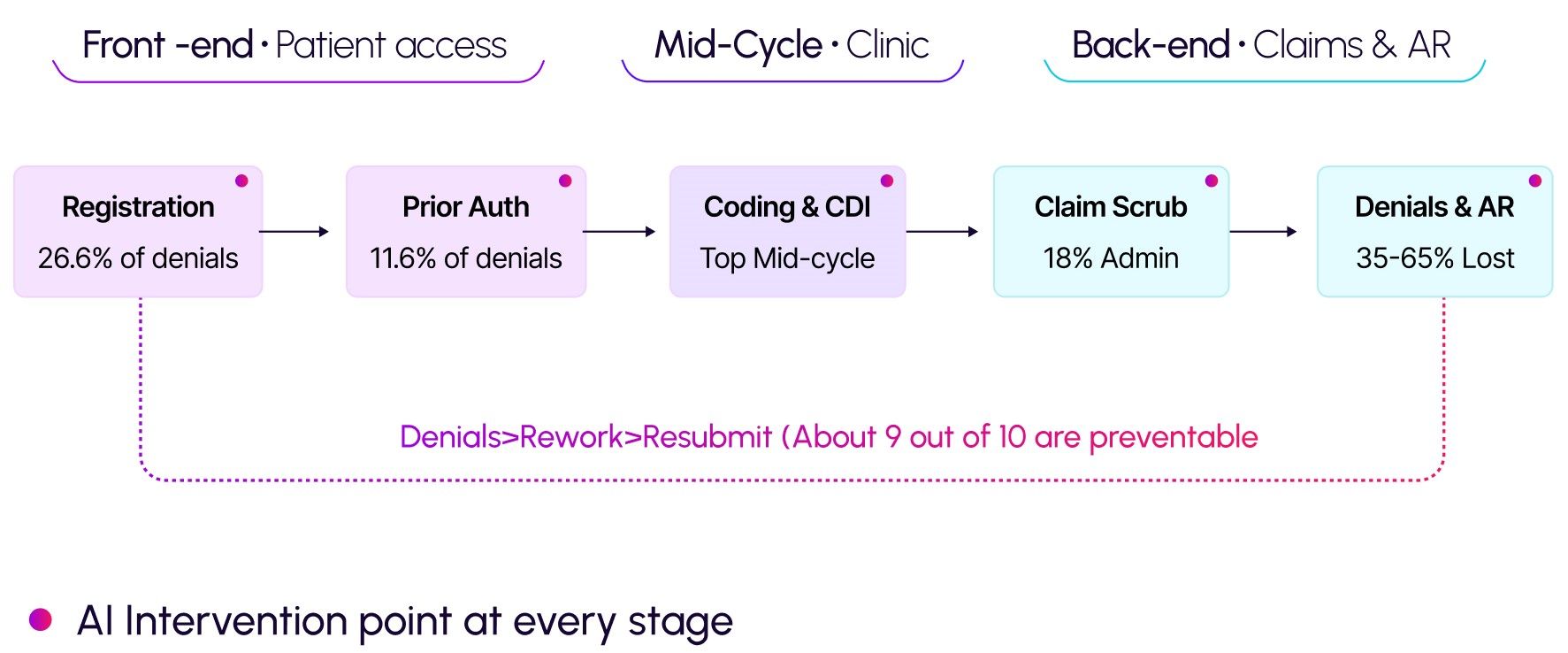
Figure 1. The provider revenue cycle across three zones. Front-end stages account for roughly half of all denials; the dashed loop is the reactive cycle most organizations live in today. Denial-share figures from the Change Healthcare Denials Index.
Registration and Eligibility: The Dirty-Data Problem
Believe it or not, most denials are born at the front desk. Registration and eligibility errors (transposed demographics, stale insurance details, missed coordination of benefits) account for 26.6% of all denials on their own. In provider surveys, 68% cite inaccurate or incomplete patient data at intake as a primary driver. The tragedy is that these are the most controllable errors in the entire cycle.
This is where AI shows its clearest, best-documented return. Real-time data capture and insurance discovery validate demographics and coverage at the moment of registration, before a flawed record can propagate downstream. One large health system reduced registration and eligibility-related denials by 42% after deploying an AI-driven patient-access tool. The error is caught in seconds instead of surfacing weeks later as a denial code.
Prior Authorization: The Speed and Compliance Trap
Authorization and precertification failures drive a further 11.6% of denials, and the pressure is intensifying as payers expand prior-authorization requirements on imaging, specialty drugs, and elective procedures. Manual PA is slow, inconsistent, and expensive to staff.
AI reframes prior authorization as an anticipation problem: detecting when an authorization is required, assembling the supporting clinical evidence directly from the record, and submitting electronically. The efficiency gains are striking. Vendors report clinician time on prior authorizations falling from minutes to seconds, and multi-agent solutions that compress processing from days to minutes. It is also becoming a compliance imperative. The CMS 2026 Interoperability and Prior Authorization Final Rule mandates that health plans publicly report authorization turnaround times, denial rates, and overturn rates beginning 31 March 2026. Clean, complete electronic PAs stop being a nicety and become a measurable advantage.
Documentation and CDI: Supporting Medical Necessity
Weak clinical documentation is the quiet upstream cause of medical-necessity denials that only detonate at the back end. The traditional fix is retrospective clinical documentation improvement, but it arrives too late. AI moves the intervention into the encounter itself, flagging documentation gaps concurrently and ensuring the note actually supports the services billed. Emerging tools integrate note generation with concurrent revenue-cycle intelligence so that documentation is accurate, compliant, and reimbursement-ready from the moment it is written.
Coding: Precision at Scale
Coding remains one of the most error-prone links in the chain, with wrong modifiers, bundling and edit violations, and a relentless cadence of code-set updates. Autonomous and computer-assisted coding has matured to the point where AI now performs at or above the accuracy of experienced human coders, with reviews of real-world deployments reporting substantial reductions in coding errors alongside faster claim turnaround. The value is not replacing coders but removing the routine, high-volume error surface that generates avoidable denials.
Claim Scrubbing: Prediction Before Submission
This is where prevention becomes measurable. Rather than relying on static edit rules, predictive engines learn payer-specific behavior and flag the claims most likely to be denied before they are submitted. Organizations using these platforms report first-pass resolution rates improving by 6 to 15 percentage points, and A/R days falling by 30 to 41%. Taken together, providers preventing denials at this stage, rather than appealing more of them, are achieving overall denial-rate reductions of 30 to 40%.
Denial Management and AR: Working Smarter, Not Harder
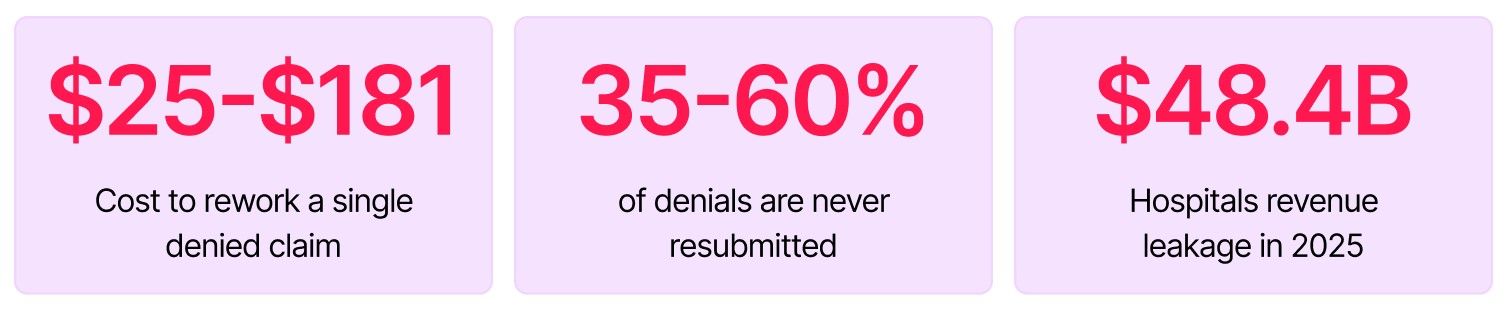
Even a well-run cycle produces some denials, and this is the reactive tail every organization knows too well. Reworking a single denied claim costs between $25 and $181, and between 35% and 60% of denied claims are simply never resubmitted. That's abandoned revenue for care that was genuinely delivered. Brutally expensive, right? AI helps by triaging denials on the likelihood of recovery and auto-drafting evidence-backed appeals, lifting appeal success rates by around 15%. But the most important lesson of this stage is that it should be shrinking, not scaling.
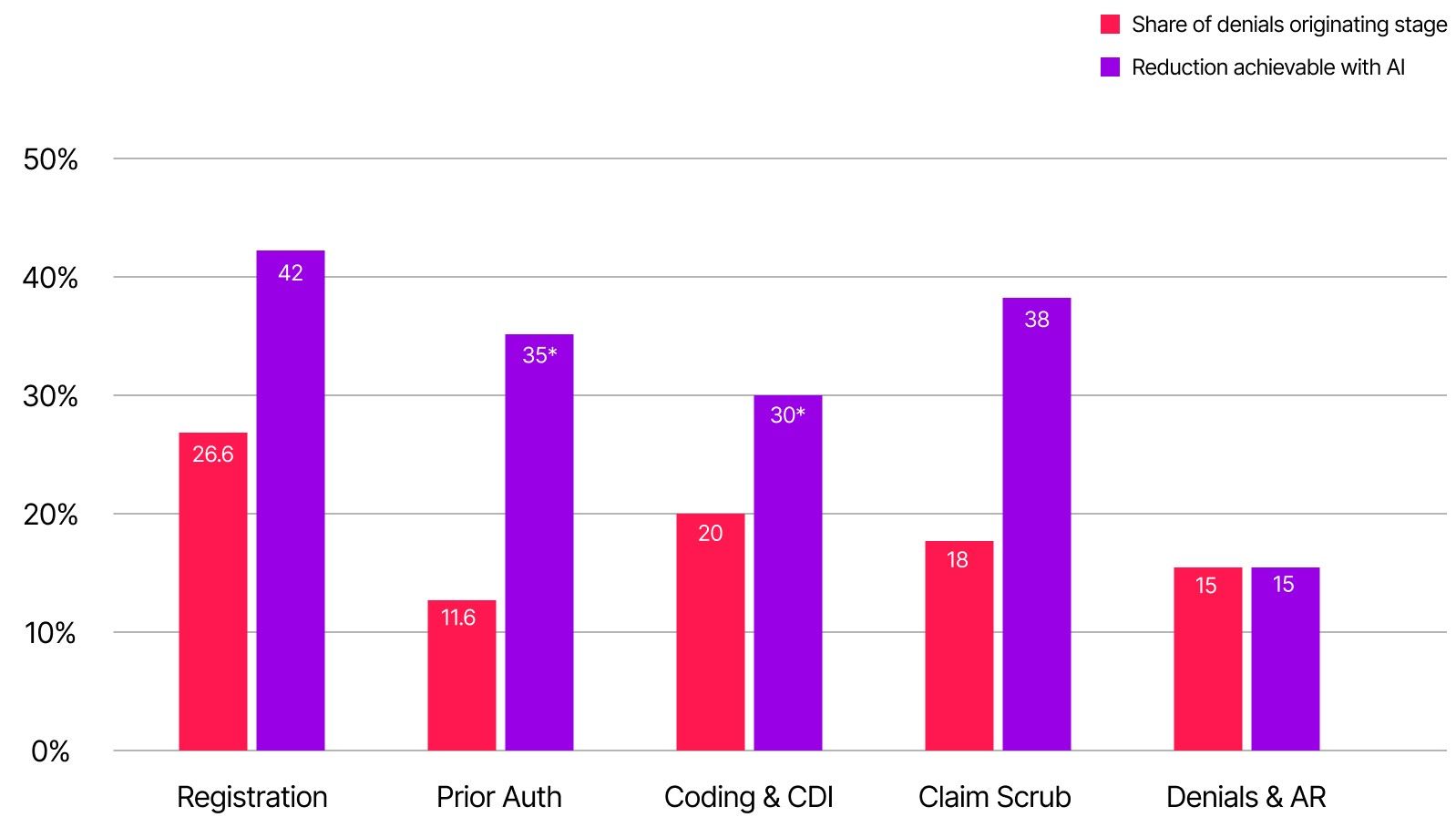
Figure 2. Where denials originate versus how much AI can remove. Registration and claim-scrubbing figures are documented denial-volume reductions. Prior-auth and coding bars are directional: the real AI gains there are speed (days-to-minutes) and accuracy (human-level coding), which prevent denials indirectly rather than through a single published percentage.
[A note on reading Figure 2: the purple bars blend two kinds of gain. Registration and claim scrubbing reflect measured reductions in denial volume; prior authorization and coding reflect gains in speed and accuracy that reduce denials without a clean single-number benchmark. The honest takeaway is directional, not that all five stages behave identically.]
The Economics of Prevention
Line the numbers up and the case makes itself. Every denied claim carries a rework cost of $25 to $181; a third to more than half are never resubmitted at all; and in 2025 alone, hospital denials drove an estimated $48.4 billion in net revenue leakage. Against that, a prevention program is not an expense but an arbitrage. It is almost always cheaper to get a claim right once than to lose it, chase it, and often abandon it.
The Adoption Gap is The Opportunity
If the economics are this lopsided, why hasn't every provider moved? Because most haven't. Only 14% of providers currently use AI to reduce denials, even though 82% call reducing denials a priority and 67% believe AI can improve the claims process. The distance between conviction and action is the whole opportunity. Among the organizations that have crossed it, 69% say AI has already reduced their denials or improved resubmission success.
The through-line for revenue cycle leaders is simple to state but hard to execute. Why? Because although denials are a front-loaded, preventable problem, the industry still concentrates its spending at the back end, chasing claims after they fail. The promise of AI is not a better appeals department. It is the ability to move the entire cycle left, so that errors are caught at registration instead of being argued about 45 days later.
The Next Denial Has Probably Already Started
The next denial in a provider's queue may still be weeks away from appearing, but the error behind it may already exist. It could be sitting in an incomplete registration record, an authorization workflow, a clinical note, or a claim that has not yet left the organization.
Revenue cycle leaders therefore need to look beyond the denial rate itself. The more useful question is where preventable risk enters the workflow, how early it can be detected, and whether teams have the data and operating discipline to act before submission.
AI makes earlier intervention possible, but technology alone cannot shift the cycle. Providers need connected workflows, payer-specific intelligence, clear ownership, and measurement that follows a denial back to its point of origin. The organizations that build those capabilities will spend less time recovering revenue they have already earned and more time preventing its loss. The denial may arrive at the back end. The decision to prevent it belongs upstream.
Stop managing denials after the damage is done.
Coditas helps healthcare organizations identify where denial risk begins and build AI-led interventions across patient access, prior authorization, documentation, coding, and claims.
Shift your revenue cycle left: Talk to us