
Bhupesh Nadkarni
A correctly identified risk is not a closed gap. In 2026, it can determine whether a Medicare Advantage contract clears the quality bonus threshold.
Population health programs do not need another list of gaps. They need a way to keep ownership, action, and evidence connected until the measure closes.
The 2026 Star Ratings release exposed a problem another risk model will not solve: too many identified care gaps still fail to become reportable care. A member may be correctly flagged, assigned for outreach, and even receive the preventive service, yet the measure remains open because evidence arrives late or documentation never reaches quality reporting.
For Medicare Advantage plans and provider organizations, the distance between identification and closure now carries direct financial weight. The enrollment-weighted average MA-PD Star Rating rose only slightly, from 3.95 in 2025 to 3.98 in 2026. Among 516 rated MA-PD contracts, 18 earned five stars, while 207, approximately 40%, earned four stars or higher. The 2026 ratings also affect 2027 Medicare Advantage quality bonus payments.
Many organizations already have mature risk stratification software, quality registries, claims analytics, and member outreach systems. The harder problem is converting that intelligence into completed, documented, and reportable care. The 2026 methodology reduced the weighting of patient experience, complaint, and access measures, increasing the relative influence of clinical quality performance. As annual cut points continue to be recalculated against contract performance, care gap closure carries greater influence over plan performance and quality bonus exposure.
How Do You Close Care Gaps to Improve HEDIS Scores and Medicare Star Ratings?
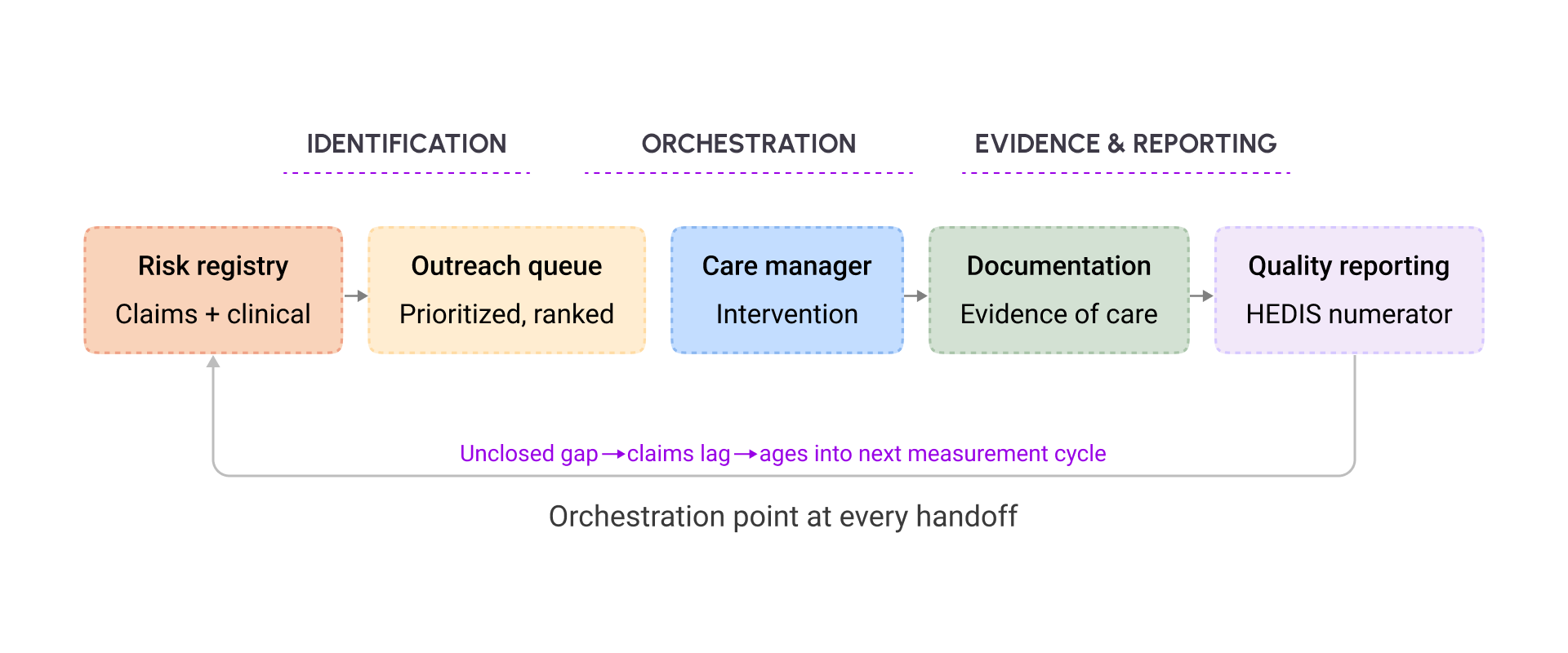
Care gap closure improves Healthcare Effectiveness Data and Information Set (HEDIS) scores and Medicare Star Ratings when a population health management platform connects current data, prioritized outreach, clinical action, documentation, and quality reporting. Ownership must remain clear throughout the workflow, and completed care must become valid evidence before the reporting cutoff.
The path begins in the registry, but the registry can only identify the opportunity. Everything that follows determines whether it closes.
01. Registry: The Risk Model Does Its Job and Stops
Risk stratification software can identify members with an open colorectal cancer screening gap, an overdue HbA1c test, or a lapsed statin fill. It can show who needs attention and which measure is at risk.
It cannot decide when the member should be contacted, which channel is most appropriate, who owns the intervention, or whether an upcoming visit creates a better opportunity to act.
For HEDIS performance, a correctly flagged member matters only when eligible care becomes a completed, documented, and reportable numerator event. The first risk emerges as soon as the registry hands the opportunity to outreach.
02. Outreach: Claims Lag Changes the Work Before Teams Can Act
A member may complete a colonoscopy outside the network while the registry still shows the gap as open. Until the claim or clinical evidence arrives, outreach continues against information that is already outdated.
Across a large population, those delays create duplicate calls, member frustration, and time spent confirming care that has already occurred. They also reduce the time available for members whose gaps remain genuinely open.
A population health management platform must therefore reconcile claims, clinical documentation, laboratory results, and supplemental data frequently enough to change the work queue when the member’s status changes. Completed services should leave the list. Uncertain evidence should move to review. Open opportunities should remain with the teams positioned to act.
Once the status is current, the next question is no longer who appears on the list. It is who should receive attention first.
03. Care Management: A Longer Worklist Is Not a Better One
A director of care management may receive thousands of open opportunities, but each one carries a different level of urgency, effort, and probability of closure.
Without prioritization, care managers must rebuild the context themselves. They check previous outreach, scheduled appointments, provider relationships, reporting deadlines, and whether another team has already intervened. Clinical time is spent preparing to act rather than completing the intervention.
A useful work queue should rank gaps using the information that changes the next decision. An overdue diabetic retinal exam may move forward because the member has an upcoming primary care visit. A preventive measure may become more urgent as the measurement window narrows. Repeatedly unsuccessful outreach may call for a different channel or a provider-led conversation.
The platform does not replace care manager judgment. It makes that judgment easier to apply at the moment it is needed. Even then, a completed intervention can still disappear from performance if the evidence does not survive the next handoff.
04. Documentation: When Completed Care Does Not Count
A care gap can close clinically and remain open in the quality registry.
The service may be documented in free text, stored in an external record, or captured in a field that does not satisfy the HEDIS numerator specification. The care occurred, but quality reporting cannot recognize it.
Point-of-care prompts can show providers which measures remain open and what evidence is required. Reconciliation can surface likely documentation across claims, laboratory feeds, clinical records, and supplemental data while there is still time to validate it.
Evidence capture is not an administrative task added after care. It is part of closing the gap.
05. Reporting: Every Earlier Loss Appears Here
The reporting cutoff exposes the cumulative effect of every weak handoff.
Stale data becomes unnecessary outreach. Poor prioritization becomes a missed intervention. Incomplete documentation becomes care that does not count.
HEDIS reporting does not count an outreach attempt, a scheduled appointment, or incomplete evidence as a closed gap. The workflow reaches its conclusion only when eligible care is completed, validated, and accepted as a numerator event.
Better risk identification improves the starting point. Medicare Star Ratings reflect what survives the full journey to reporting.
Where Does AI Strengthen a Population Health Platform?
AI adds value when it helps the population health management platform keep the care gap closure workflow current.
It can identify likely evidence in unstructured clinical notes, reassess priorities when new claims or appointments appear, and recommend the next action based on the reporting deadline, member history, and clinical context. During an existing provider visit, it can also surface an open care opportunity before a separate outreach cycle becomes necessary.
Care managers, clinicians, and quality professionals retain responsibility for clinical decisions and evidence validation. AI supports them by reducing avoidable outreach, shortening the path from identification to action, and preventing completed care from disappearing before quality reporting.
In practice, AI should be judged by whether it keeps the workflow current and preserves evidence through reporting. Coditas’s care-gap-detection analytics applies the same principle by reconciling claims and clinical documentation against open gaps, so the work queue reflects the member’s current status rather than an earlier snapshot. The value lies in moving detection closer to action, not in producing another isolated risk score.
Why Does Care Gap Closure Protect Medicare Star Ratings in 2026?
Care gap closure affects Star Rating performance when eligible services are completed and accepted in quality reporting. An overdue screening, test, or medication refill may create an opportunity, but only validated evidence can improve the measure tied to it.
A population health management platform protects those opportunities across three parts of the workflow:
- Current registries remove completed services from work queues and keep genuinely open gaps visible.
- Prioritized outreach helps care managers focus on gaps that can still be closed within the reporting window.
- Point-of-care prompts and evidence capture connect completed services to the documentation required for HEDIS reporting.
A platform cannot influence every component of a Medicare Star Rating. It can help improve performance on measures linked to preventive care, chronic disease management, medication adherence, and follow-up. For contracts near the four-star threshold, stronger closure performance can support HEDIS results, quality bonus eligibility, and rebate value.
The Platform Should Be Judged by What Reaches the Numerator
A population health platform proves its value through closure performance, not through the number of risks or gaps it identifies.
Healthcare leaders should evaluate whether the system helps teams convert identified opportunities into validated numerator events before the reporting cutoff. The most useful measures are closure rate, time to closure, documentation completion, and the proportion of completed services accepted in quality reporting.
A larger gap list shows that the organization can find more work. A higher rate of validated numerator events shows that the platform can help complete it.
As clinical quality performance carries greater relative influence and cut points are recalculated each year, plans have less room to lose completed care between identification and reporting. The organizations that close it fastest will not be the ones with the most complete risk model, but the ones that can prove which opportunities actually became reportable care.
If you want to see where that gap may be forming in your own care gap closure workflow, contact us to start the conversation.