
Abhishek Ghosh
Understanding the AI Maturity Curve and Why Most AI Ambitions Collapse Before They Scale
“Govern applications, not technology. Automate tasks, not jobs.”— Andrew Ng, Founder & Executive Chairman, Landing AI
In 2025, global AI investment has crossed $240 billion, yet over 70% of enterprise AI projects fail to reach production. The gap isn’t technical—it’s structural. Most businesses start strong with experiments and pilots, but stall when it’s time to scale.
How about closing that gap?
If you’re a decision-maker, tech leader, or someone driving AI initiatives, this is a practical breakdown of the AI maturity curve - what it looks like, how to know where you stand, and what it actually takes to move from one stage to the next.
We’ll explore:
- Why do so many AI initiatives get stuck in PoC mode
- What defines real AI maturity (hint: it’s not how many models you’ve deployed)
- A clear roadmap to move from experimentation to enterprise-wide adoption
- And how we at Coditas have helped clients scale with purpose, not just pilots
Let’s get into it.
The AI Maturity Curve: A Quick Primer
AI adoption isn’t a single step. It’s a gradual climb. Some companies are still testing models in isolated teams. Others have AI built into how they run their business every day. That difference is what we call the AI maturity curve.
This curve shows how organizations move from early experiments to structured, scalable AI systems. It’s not about hype or ambition. It’s about how much value AI delivers and how repeatable that value is.
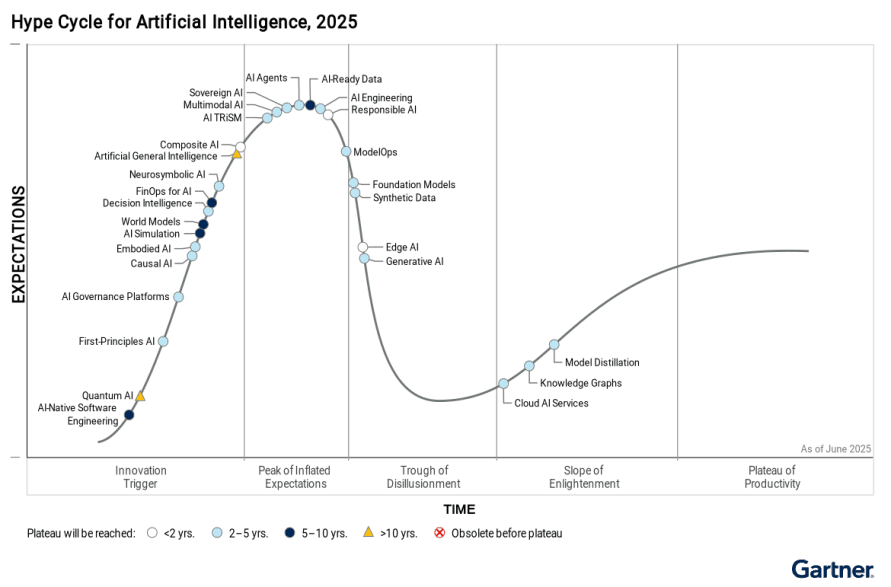
The 2025 Hype Cycle for Artificial Intelligence (Credits: Gartner)
We’re using a four-stage version of the curve. It pulls ideas from reports by Bond Capital, MIT-CISR, and CGI. Here’s what it looks like:
- Experimentation – AI pilots sit in silos. Teams run PoCs, often with no real business involvement. Nothing scales.
- Operationalization – A few models go live. Results are mixed. There's no clear process for building or managing AI.
- Integration – AI shows up across functions. Tools improve. Infrastructure becomes reliable. Teams share data and insights.
- Systemic AI – AI connects to how the business thinks and operates. It supports real decisions. Governance and measurement are built in.
Most companies are somewhere between Stage 1 and Stage 3. Reaching the last stage isn’t easy, but it’s where the real progress happens.
Let’s check what’s happening at each level and what you need to move forward.
Stage 1: Experimentation – The PoC Pitfall
Most companies start here. They built something small to test the waters. A chatbot. A recommendation model. A GenAI feature that looks good in a demo. Sometimes it works. Sometimes it doesn’t. However, it rarely moves beyond the lab.
This stage is about proving a point. The goal is to explore what’s possible, not to commit to anything long-term. That’s fine in the beginning. The problem is when companies stay here for too long.
Common patterns:
- PoCs are driven by innovation teams, not product or business teams.
- There’s no clear success metric tied to real outcomes.
- The data used is either limited, messy, or not connected to production systems.
- AI is treated like a side project, not part of core operations.
After a few months, leadership starts asking, “Why haven’t we launched anything yet?” And that’s the trap. Pilots keep piling up, but no one knows how to move from experiment to execution.
To break out of this stage, companies need three things:
- Clear problem framing – Know what you’re solving and who it’s for.
- Data discipline – Use real, usable, business-grade data.
- Executive buy-in – AI must have a business owner, not just a technical lead.
Without this shift, even good models won’t go anywhere. The tech might work, but the business won’t feel it.
Stage 2: Operationalization – Tinkering Meets Reality
This is where AI starts to show up in production. A few use cases go live. A customer support bot handles real queries. A demand forecasting model feeds into planning. Early signs look promising. Teams begin to feel like they’re making progress.
But the cracks show up fast.
Models are running, but the infrastructure around them is shaky. Monitoring is limited. Data pipelines break. Teams are working in silos. When something fails, no one’s sure who’s responsible.
This is what operationalization often looks like:
- One team owns the model. Another team owns the app it lives in.
- DevOps isn’t equipped for AI. MLOps is either missing or improvised.
- Retraining happens manually. Testing is inconsistent.
- There’s no formal governance around how AI is built or used.
The organization is past the PoC stage, but not ready to scale. AI is real, but fragile. It delivers some value, but not consistently. And when people leave, so does the system knowledge.
To move forward, companies need:
- Reliable infrastructure – That includes version control, testing, monitoring, and deployment pipelines.
- Cross-functional alignment – Data science, engineering, and product teams must speak the same language.
- Governance and documentation – So people know what’s running, what it’s doing, and why it matters.
Getting to this stage is a sign of progress. However, staying here means you’re still doing AI around the edges, but not at the core.
Stage 3: Integration – Building for Scale
This is the turning point. AI stops being a side project and starts becoming part of how work gets done. Models are connected to business workflows, apart from just running. They support decisions. They update based on feedback. They scale across teams.
You’ll know you’ve reached this stage when AI shows up in multiple departments and people actually use it.
What this looks like:
- A churn prediction model feeds directly into CRM campaigns.
- A GenAI tool helps support agents write responses in real time.
- Anomaly detection flags issues before customers report them.
- Internal tools use AI to recommend next steps, not just display dashboards.
Teams reuse components instead of rebuilding from scratch. Data pipelines are shared. Feature stores are in place. Deployment is repeatable. There’s still cleanup to do, but the foundation holds.
Common traits at this stage:
- A central AI platform or toolkit begins to emerge.
- MLOps is treated like engineering, not experimentation.
- Business teams start asking for AI without resisting it.
- Feedback loops improve models based on usage and outcomes.
To move from integration to systemic maturity, organizations need:
- Shared infrastructure – So teams aren’t solving the same problems in isolation.
- Product thinking – AI initiatives are owned, measured, and improved like any other product.
- Executive alignment – AI is tied to strategy, not just operations.
At this point, AI isn’t something the company is experimenting with. It’s something the company depends on. But there’s still one level left.
Stage 4: Systemic AI – Platform Thinking
Very few companies reach this stage. Not because it’s out of reach, but because it requires more than tech. It demands structure, ownership, and long-term thinking.
Systemic AI means AI isn’t a tool you use. It’s a system you run. It’s built into how the company plans, operates, and grows. You’ll find it in strategy decks, operational reviews, and even hiring plans.
What it looks like:
- AI helps define pricing, allocation, personalization, hiring, and more.
- Teams use shared platforms to build and deploy models fast and safely.
- AI outcomes are tracked like revenue or cost metrics.
- Governance, ethics, and explainability are not afterthoughts as they’re part of design.
At this stage, AI isn’t a “project” anymore. It’s part of your business DNA.
You’ll also see:
- Dedicated platforms for experimentation, testing, and retraining.
- Built-in observability and feedback for every model in production.
- KPIs that measure impact, not just activity.
- Company-wide awareness of what AI is doing and where it adds value.
What gets you here:
- Leadership that treats AI as core infrastructure, not an optional feature.
- Design standards for reliability, fairness, and accountability.
- Systems that support change, because models drift, and so does the market.
Systemic AI doesn’t mean more models. It means better decisions, made faster, and at scale. This is where AI earns its place more than just as an innovation badge, evolving into a business engine.
How Coditas Helps Enterprises Level Up
We’ve seen what it looks like at every stage. From short-lived pilots to AI systems that support how an entire business runs. But getting from one stage to the next doesn’t happen on its own. It takes technical depth, structured execution, and a clear link to outcomes.
That’s where we come in.
At Coditas, we help clients move from scattered experiments to reliable, scalable AI platforms. We’ve worked with companies that were stuck in PoC mode for years—sometimes with strong models, but no way to ship or support them. Our job is to close that gap.
Here’s how we do it:
- We bring both AI and engineering to the tableA working model isn’t enough. We help teams build pipelines, APIs, and tooling so that models can be deployed, monitored, and updated without breaking things.
- We design for reuse and scaleWhen every team builds in isolation, progress is slow. We help centralize common components, so your second model takes half the time of your first.
- We support the full AI lifecycleFrom data prep and training to testing, CI/CD, and observability, we set up systems that don’t fall apart after launch.
- We track what mattersWhether it’s speed, cost, or accuracy, we help define and measure impact so AI doesn’t just run—it performs.
- We build with people in mindWe don’t just hand off code. We work closely with product, engineering, and data teams so that what we build fits into how your teams already work.
“Our role is not to 'transform' a business. It’s to make progress real and repeatable. That’s what separates good AI ideas from long-term value.”— Varun S, Co-founder & Head of GenAI, Coditas
Conclusion: The Real Maturity Isn’t Tech. It’s Impact.
It’s easy to launch a pilot. Harder to launch a product. Hardest to build a system that lasts.
AI maturity isn’t about how advanced your models are. It’s about whether they’re used, trusted, and tied to real outcomes. That’s the difference between a promising start and long-term value.
So here’s the question worth asking: Which stage are you really in?And more importantly, what’s stopping you from moving forward?
If you’re ready to stop building in circles and start building systems that work at scale, you don’t need a roadmap full of jargon. You need a partner who can build with clarity, care, and control.
That’s what we do at Coditas. And if you're ready, we're here to help.