
Bhupesh Nadkarni
For decades, healthcare has been a balancing act. William Kissick, the father of the US Medicare program, described it as an “iron triangle” of access, quality, and cost containment. Improving one often comes at the expense of the others. In response, healthcare systems have focused on efficiency by digitizing records, streamlining workflows, and optimizing resource allocation.
Yet, these efforts have reached their limits. Despite widespread EHR adoption, providers still struggle with fragmented data, limited healthcare interoperability, disconnected systems, and decision-making bottlenecks. Healthcare organizations generate vast amounts of patient data, but much of it remains trapped in silos, limiting its potential to improve care. Practitioners & Caregivers require more than just digital tools. They need seamlessly connected care workflows that bring together data, insights, and real-time collaboration.
The next wave of healthcare innovation will not come from incremental efficiency gains. It will come from building intelligent, connected healthcare ecosystems, built around a care coordination platform, that integrate hospitals, payers, diagnostics labs, and medical devices into a seamless network. These ecosystems do more than store data. They synthesize, interpret, and act on it in real time, driving smarter, faster, and more proactive care.
Organizations that invest in this transformation today will define the future of healthcare delivery. The question is, how do we get there?
What Defines a Connected Healthcare Ecosystem?
A truly connected digital healthcare ecosystem seamlessly integrates eight key stakeholders—Patients, Providers, Practitioners & Caregivers, Pharmacies, Payors & Insurers, Product Manufacturers & Pharma, Partners & Platforms, and PathLabs & Diagnostics. Despite the rapid digitalization of healthcare, they still operate in silos. Critical information is fragmented, workflows remain disjointed, and collaboration is slow. The result is inefficiency, higher costs, and suboptimal patient care.
Building a truly connected ecosystem requires more than technology adoption. It demands an architecture centered around the 8Ps of healthcare—integrating data, workflows, and interactions across all key stakeholders:
- Patients – Require seamless access to medical records, AI-driven health insights, and coordinated care pathways.
- Providers – Hospitals, clinics, and telehealth services leveraging AI for workflow automation, predictive analytics, and improved patient management.
- Practitioners & Caregivers – Depend on real-time insights to optimize diagnosis, treatment planning, and long-term patient monitoring.
- Pharmacies – Rely on AI-powered prescription tracking, adherence management, and automated drug interaction monitoring.
- Payors & Insurers – Optimize claims processing, risk assessment, and preventive care strategies using AI-driven intelligence.
- Product Manufacturers & Pharma – Apply AI to drug discovery, precision medicine, and medical device innovation.
- Partners & Platforms – Provide digital infrastructure for interoperability, regulatory compliance, and secure data exchange.
- PathLabs & Diagnostics – Utilize AI to enhance diagnostic accuracy, automate reporting, and integrate seamlessly with provider networks.
To enable seamless interactions across these stakeholders, compliance with HIPAA, HL7, FHIR, and CDA is non-negotiable. A connected healthcare ecosystem must ensure real-time, secure data exchange while maintaining trust.
"Organizations that successfully implement AI-powered, interoperable workflows tailored to the 8Ps will lead the industry’s transition from fragmented, reactive care to a truly connected, proactive healthcare model."
Biggest Roadblocks to Fully Connected Digital Health Ecosystems
Despite the industry’s rapid shift toward digital transformation, fully connected healthcare ecosystems remain an elusive goal. Many organizations have embraced EHRs, AI, and data-sharing frameworks, yet structural, technological, and regulatory challenges continue to stall real-time connectivity.
To build a truly integrated system, three critical roadblocks must be addressed:
1. Interoperability Exists—But It’s Not Enough
While EHR adoption is nearly universal, healthcare organizations still lack a truly integrated infrastructure where systems exchange real-time data beyond their immediate networks. Limited cross-provider collaboration, fragmented payer-provider interactions, and outdated IT frameworks prevent healthcare from reaching full digital maturity.
2. The Data Paradox: Too Much, Yet Not Enough
The healthcare industry generates exabytes of patient data daily, yet most of it is unusable in decision-making. Physicians don’t just need access to data. They need curated, relevant, and contextual insights at the point of care. Without intelligent filtering and synthesis, more data simply adds to cognitive overload rather than improving outcomes.
3. Compliance Is Essential—But It Slows Down Progress
Security and privacy frameworks are non-negotiable, yet global variations in regulatory policies create roadblocks. Many healthcare organizations struggle to balance data-sharing innovation with strict compliance requirements. Without standardized governance models, scaling connected ecosystems remains complex and resource-intensive.
How AI Powers the Next-Gen Connected Healthcare Ecosystem
The transition from fragmented healthcare systems to intelligent, connected ecosystems requires more than digital adoption. Artificial intelligence (AI) serves as the backbone of this transformation, enabling seamless data exchange, real-time clinical insights, and predictive care models. With the addition of AI across workflows, healthcare organizations move beyond static data-sharing to proactive, insight-driven decision-making.
AI delivers impact across three critical areas:
1. AI-Enabled Data Orchestration: Turning Disconnected Records into Unified Insights
A leading genomics company faced significant inefficiencies in patient risk stratification and genetic screening workflows. Traditional systems relied on manual data extraction from medical histories and lab results, delaying the identification of high-risk patients.
By integrating AI-driven data orchestration, the company developed an automated, HIPAA-compliant platform that:
- Consolidated patient records from multiple EHR systems and health information exchange feeds.
- Applied machine learning models to detect hereditary risk factors.
- Enabled a fivefold increase in at-risk patient identification, improving early intervention rates.
2. AI-Augmented Clinical Decision Support: Moving from Reactive to Predictive Care
In another case, a national healthcare network leveraged AI-powered clinical decision support to optimize chronic disease management.
Using predictive analytics, the system:
- Analyzed historical patient data to detect care gaps.
- Identified at-risk patients before complications arose.
- Reduced hospital readmissions by 18% within the first year of deployment.
3. AI-Driven Operational Efficiency: Automating the Administrative Burden
A healthcare provider managing medical coding and claims processing struggled with high administrative costs and slow reimbursement cycles. AI-powered automation helped:
- Standardize medical coding, reducing claim errors by 42%.
- Accelerate claims adjudication, cutting processing time by 50%.
- Improve payer-provider alignment, minimizing disputes.
Organizations that integrate AI as an enabler of connected ecosystems will redefine healthcare delivery—bridging silos, improving efficiencies, and unlocking new levels of patient-centric innovation.
The Future of AI-Powered Connected Healthcare Ecosystems
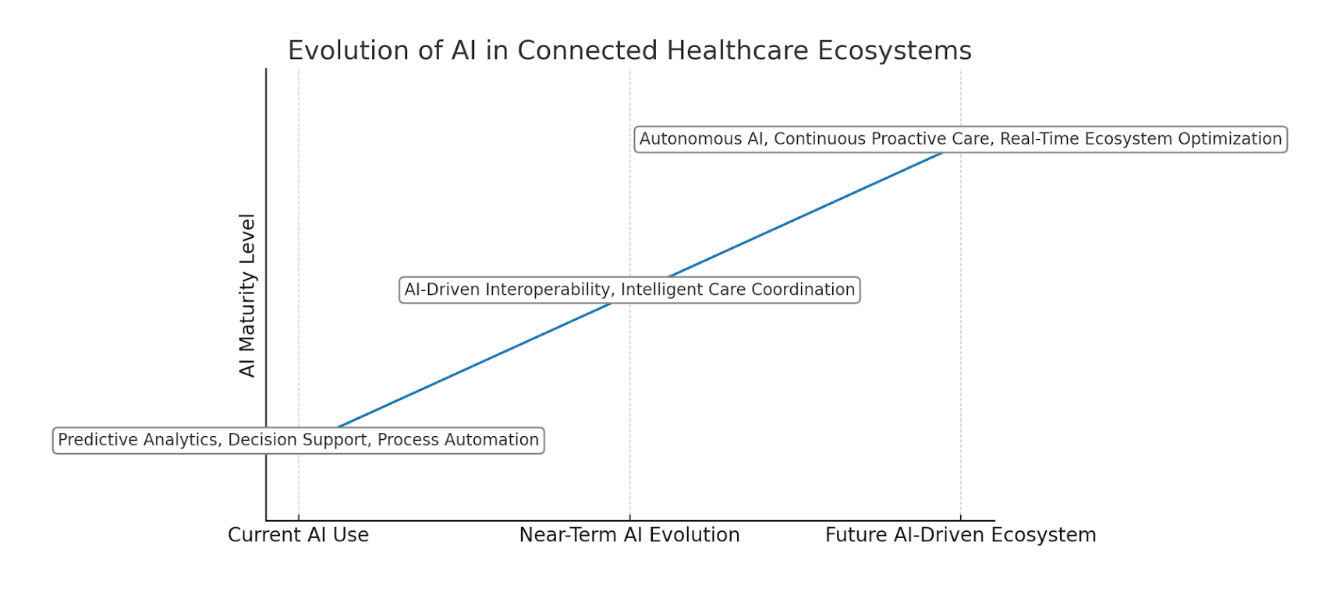
The next evolution of AI in healthcare will not be defined by incremental improvements, but by the creation of fully autonomous, intelligence-driven ecosystems. While AI is already transforming clinical workflows, data integration, and decision support, its true potential lies in building interconnected networks that optimize care delivery in real time.
To understand where the industry is headed, three critical shifts will shape the future of AI-powered healthcare ecosystems:
1. AI-Driven Interoperability: Beyond Data Exchange to Intelligent Collaboration
Current interoperability efforts focus on structured data exchange across EHRs, payors, and providers, including payer provider interoperability. The future, however, will move beyond technical connectivity to intelligent collaboration—where AI not only integrates information but also prioritizes, contextualizes, and recommends actions.
A leading genomics company has already implemented AI-powered data orchestration, allowing seamless risk stratification and genetic screening integration across multiple healthcare providers. Future AI-driven networks will extend these capabilities across entire healthcare ecosystems, enabling real-time coordination between providers, pharmacies, and path labs.
2. Autonomous AI in Clinical and Operational Decision-Making
Today, AI assists in clinical workflows through predictive analytics and recommendation engines. Clinical workflow automation is what teams expect now. The next phase will see AI moving from decision support to autonomous execution—handling routine processes such as triage, patient monitoring, and treatment optimization with minimal human intervention.
A national healthcare network leveraged AI to optimize chronic disease management, reducing hospital readmissions by 18%. In the future, AI will take this further—autonomously adjusting treatment plans based on real-time biometrics and longitudinal patient data.
3. AI as the Backbone of Continuous, Proactive Care
The future of healthcare will shift from episodic interventions to continuous, AI-driven patient engagement. AI-powered remote patient monitoring will integrate wearables, at-home diagnostics, and digital biomarkers, allowing healthcare systems to intervene before conditions escalate.
A leading healthcare provider has already seen a 42% reduction in coding errors and a 50% acceleration in claims adjudication by deploying AI-driven automation. Future AI-driven ecosystems will embed these efficiencies into real-time patient monitoring and predictive interventions.
Architecting AI-Powered Healthcare Ecosystems for Connected Medical Devices
The healthcare industry is at a pivotal moment. Traditional, siloed models of care are no longer sustainable. The shift toward AI-powered connected ecosystems is redefining how providers, payors, and patients interact—moving from fragmented, reactive care to proactive, insight-driven health management.
Organizations that embrace AI-driven interoperability, predictive analytics, and intelligent automation today will set the new standard for healthcare delivery. The challenge is no longer just about digitization, but about architecting AI-enabled ecosystems that seamlessly connect data, workflows, and decision-making.
At Coditas Health, we are co-architecting this future—helping enterprises build scalable, AI-driven healthcare ecosystems that break silos, enhance collaboration, and deliver true patient-centric care.
HIMSS 2026 is where these conversations take shape. As AI’s role in healthcare expands, the question is no longer whether to invest in connected ecosystems—but how to build them intelligently. The future of healthcare will be defined by those who leverage AI to unlock new frontiers in precision medicine, operational excellence, and innovation.
Join us at HIMSS26, AI-Future-of-Healthcare Pavilion | Booth #10224.