
Gaurav Ghate
What Happens When Human Support Can’t Scale Fast Enough
As digital platforms grow, so do user expectations. In education, where millions of students rely on timely advice to shape their academic future, even small delays in support can create a long-term impact.
A 2024 McKinsey study found that 72% of Gen Z students expect real-time answers when interacting with educational platforms. But most systems still rely on human-led support models that struggle to scale under pressure.
One of India’s leading EdTech platforms faced this exact challenge. Their counselor-driven query system worked well—until it didn’t. With student demand surging and resources stretched, the delays began to erode user experience.
Let’s take a look at how Coditas helped its EdTech client reimagine its support system using AI, real-time data access, and contextual intelligence. If you're looking for a way to scale without losing depth, this might be the framework you've been searching for.
The Hidden Cost of Manual Student Support
For platforms handling high volumes of student queries, human-led support creates friction that often goes unnoticed. Response times increase, counselors face bandwidth constraints, and student trust declines when expectations for immediacy aren’t met.
A leading EdTech platform in India serves over 20 million students, parents, and educators each month. The platform provides insights on colleges, entrance exams, and career paths, serving as a decision-support engine for the education journey.
To address the rising strain on its support system, the platform partnered with Coditas. What began as a user experience challenge exposed a deeper operational issue. Quality support was becoming harder to scale, and continuing with the existing model was no longer sustainable.
A Smarter System That Knows What to Say and When to Say It
Scaling student support meant more than adding staff. It required a system that could deliver accurate, contextual responses in real time.
Coditas collaborated with the platform’s internal teams to design an AI assistant capable of resolving queries in under ten seconds. Built on Meta’s LLama 3.3 model, the assistant could interpret a wide spectrum of academic questions and return responses that felt both relevant and precise.
To ensure alignment with constantly evolving content and data, Coditas implemented a real-time data pipeline connected to the platform’s PostgreSQL infrastructure. Each response was drawn from the latest version of the database, eliminating latency and reducing content drift.
The assistant was deployed through a lightweight React interface designed for clarity and ease of use. Students no longer had to navigate menus or search sections. A direct question triggered an immediate, tailored response—reducing friction and improving first-contact resolution.
How Coditas Engineered Real-Time Guidance at Scale
The solution needed to meet three core requirements: process natural language input, generate context-aware responses, and deliver them using real-time data. Coditas addressed this through three integrated layers: AI reasoning, data access, and user interaction.
- The intelligence layer leveraged Claude 3.5, a large language model built to handle diverse educational queries. LangChain supported memory and response routing. LangFuse enabled performance tracking and system optimization.
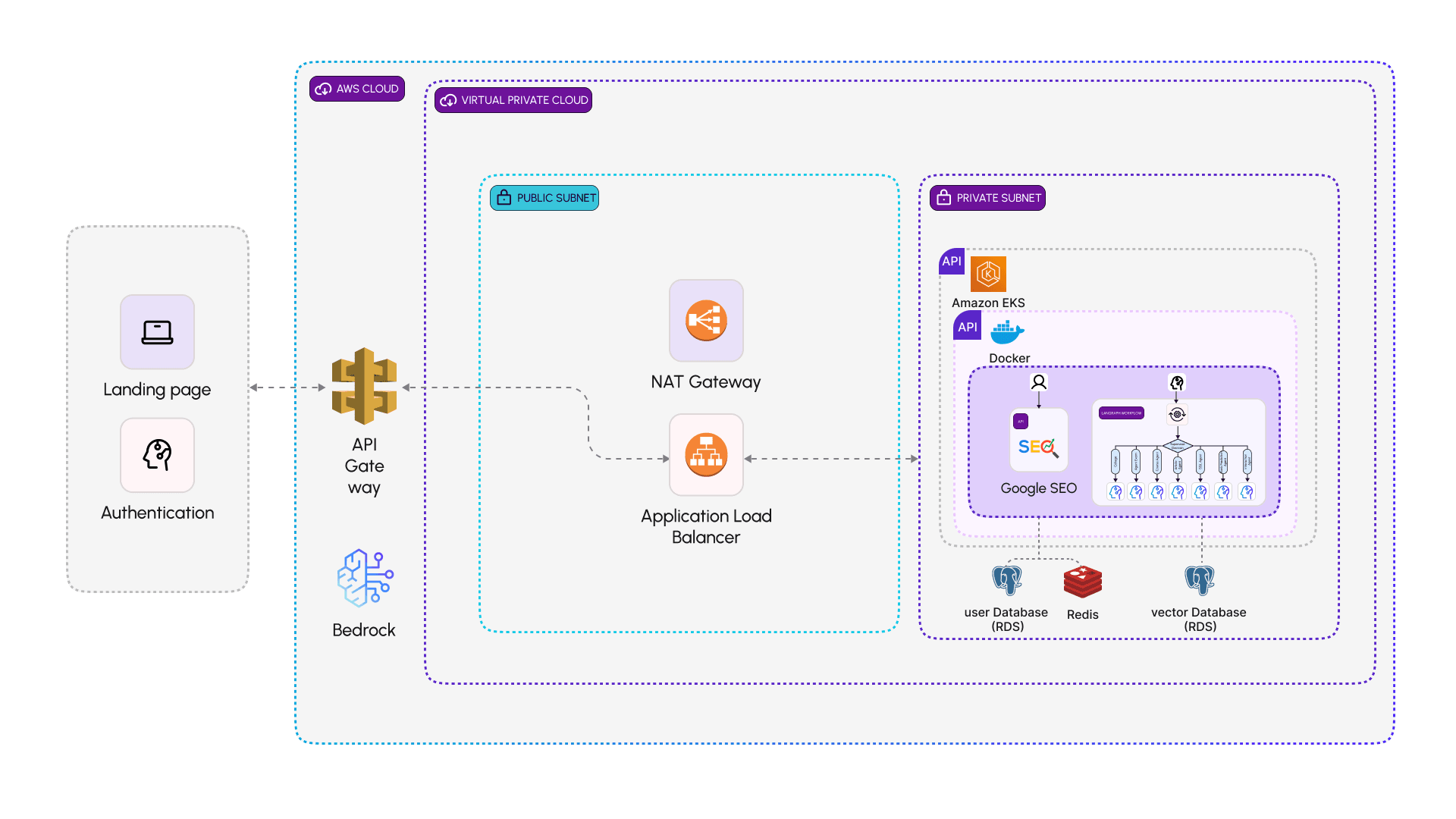
- To ensure reliability at scale, the system ran on modular cloud infrastructure:
- Amazon RDS for structured data
- API Gateway for secure access
- AWS Lambda for event-driven orchestration
- ECS (Fargate) for AI orchestration and microservices deployment
- Amazon S3 for logs, training data, and documentation
- AWS IAM for access control
The assistant’s React-based frontend ensured responsive interactions. It was embedded across high-traffic areas—home, results, and support pages—providing contextual assistance where students needed it most.
From Minutes to Seconds: What Changed for the Client
Post-deployment, the assistant consistently responded within five to seven seconds—replacing manual workflows that previously introduced multi-minute delays.
This performance shift improved the user experience immediately. Students no longer waited for callbacks or searched across pages for answers. The platform responded faster, scaled better, and handled peak load without degradation.
On the backend, the counselor workload dropped substantially. Routine queries—like exam dates, eligibility, and college lists—were managed by the assistant, allowing human support to focus on complex, high-value interactions. This improved both efficiency and staff engagement.
The assistant operated on live data, pulling directly from the latest database version. As new institutions, tests, or criteria were added, responses remained accurate without requiring manual intervention. The platform moved from reactive support to a scalable, data-aligned system that responded in real time and adapted as the platform evolved.
This Isn’t Just for EdTech
The challenges faced by high-traffic digital platforms are not limited to education. Industries such as banking, healthcare, insurance, and public services also deal with a high volume of complex user queries where speed and accuracy are critical.
The demand for scalable, context-aware support systems continues to grow. Traditional approaches often fall short, especially under heavy usage. Adding more people is not a sustainable solution.
What worked for the client can be applied elsewhere. The system architecture is flexible. The AI components are adaptable. The results offer a clear path forward for organizations that need to improve service delivery while managing scale.
This solution does more than accelerate responses. It redefines how intelligent systems can complement human decision-making at an operational level.
Scaling with Intelligence, Not Just Infrastructure
The shift from manual support to intelligent systems is no longer a future ambition. It is a present-day necessity. For the organization, the transition meant more than operational efficiency. It redefined how students access guidance at scale, without losing trust or clarity.
This solution proves that scale and personalization do not have to compete. With the right architecture and focused implementation, both can move forward together.
At Coditas, we approach complex challenges like these with a mix of engineering precision and real-world pragmatism. Whether you are in education or any other high-demand domain, the question remains the same — how do you scale meaningfully?
This is one possible answer. And it works.